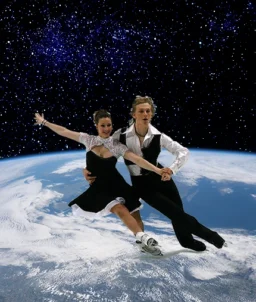
 Recent discussions in the Think Tank have led me to consider the nature of “spiritual experience.” To gain some insight into the matter, watch the following video and then read on. You can stop the video after the routine. The rest is commentary.
Ok, I admit it: Watching this was a spiritual experience for me. (That’s hard to admit because it’s a slippery slope; first you’re into figure skating, then you find yourself putting up pictures of ponies on your bedroom wall. I’m not into ice-skating and I’ve never found an ice-skating routine that moving before. Honest injun.)
I think I’ve figured out why this was a spiritual experience for me.
A fundamental human drive or even imperative is to reach for the infinite/Imitatio Dei. That translates into a transformation from the concrete and material to, eventually, the completely abstract. Over the millennia, humanity seems to be progressing in this regard, which gives me great hope. We came down from the trees completely into the concrete world. It took time and genius to make the first cave painting. To take something from the concrete world and make a representation of it was a brilliant leap toward the abstract—a spiritual leap. Since then, improvements in representational technique may be admirable, but they are not further leaps toward the abstract—they’re technical. Which is why the art that moves Rabbi Cardozo does not move me. It may impress me. I may find it beautiful. But abstract art moves me.
Any human endeavor to reach for the infinite/the completely abstract moves me spiritually. The figure skating routine we saw required so much appreciation for the abstract in order to be admired by the thousands of people who applauded it. Someone had to think of ice as a medium for beauty, not just transport. Someone had to think it worthwhile to train flightless humans to soar and glide, for no reason. Why do people want to see this? It does not put food into their mouths, or make them warm, or raise their position in the social hierarchy. It is an absurd act of defiance against the physical. It is heartbreakingly noble. We’re never actually going to get off the ground, but we never give up trying.
So why do I call this a spiritual experience rather than a religious one? Because it is informed by my instinctual recognition of this routine as highly abstract in its beauty. I posit that what turns a spiritual experience into a religious one is the training and preparation that creates a religiously shaped receptacle for an experience or at least a religious vector for channeling the experience. For the skater, the rigor that is required to become an accomplished figure skater does not create a religiously-shaped receptacle for the expression of the abstract. It creates something else (I guess). I imagine that it might be a spiritual high to finish that routine. I don’t think it could be a religious high, unless the skater also has religious training. Religious training channels the spiritual into a religious experience, and the occasional religious high.
And that’s why I love religion in general and Judaism in particular. Religion is an absurd act of defiance against the purely material. And the rigor of the training of a halachic life creates a receptacle or vector for channeling fleeting moments of spirituality into further physical religious acts in the material world that in turn encourage the continued defiance against that same world. (Of course, a further advantage of halacha is that even if it results in no awareness of defiance of the physical, it makes the physical world a better place. That’s good enough for me.) If having witnessed this routine—this beautiful, absurd, abstract act of defiance—encourages me to get off my chair and pray or remember to make a blessing after I eat, or to be nice to someone I might otherwise have ignored, then I’ll know that it was a religious experience, and not just a nebulous spiritual one.
I recommend reading William James’ The Varieties of Religious Experience if you haven’t already. In any case, for the extreme summary, here’s a bit from Wikipedia:
There are four key characteristics of religious experience: ‘passivity’, ‘ineffability’, ‘a noetic quality’ and ‘transiency’. Due to the fact that religious experience is fundamentally ineffable, it is impossible to hold a coherent discussion of it using public language. This means that religious belief cannot be discussed effectively, and so reason does not affect faith. Instead, faith is found through experience of the spiritual, and so understanding of belief is only gained through the practice of it.
I think here that James is actually talking about spiritual experience, rather than religious experience, at least at the beginning of the paragraph. Maybe it takes reason, training, commitment, and rigor to transform spiritual experience into religious experience.
Last week, my fellow Think Tank member, Michael, shared with us “Before the Law,” a parable by Franz Kafka. He said that reading the Kafka piece is (almost?) a spiritual experience for him, leaving him moved but static and therefore sad. I think that if he’s ever inspired by the piece to try to push away barriers and reach for the better world he thinks is behind them, then reading the piece may move from the realm of undefined spiritual experience into the realm of religious experience.
The Kafka piece reminds me of this mashal of the Baal Shem Tov’s:
|
A king, by magic, surrounded his palace with many walls. Then he hid himself within the palace. The formidable walls were arranged in concentric circles, one inside the other, and they grew increasingly larger—higher and thicker—as one approached the center. They had fortified battlements and were manned by fierce soldiers who guarded from above; wild animals—lions and bears—ran loose below. All this was so that people would have proper awe and fear of the king and not all who desired to approach would be allowed to do as they pleased.
The king then had proclamations sent throughout the kingdom saying that whoever came to see him in his palace would be richly rewarded and given a rank second to none in the king’s service. Who would not desire this? But when many came and saw the outer wall’s awesome size and the terrifying soldiers and animals, most were afraid and turned back. There were some, however, who succeeded in scaling that wall and fighting past the soldiers and animals, but then the second wall loomed before their eyes, even more imposing than the first, and its guards even more terrible. Seeing that, many others turned back. Moreover, the king had appointed servants to stand behind the walls to give money and precious stones to whoever got beyond each wall. Those who had crossed one or a few walls soon found themselves very rich and satisfied with what they had gained from their efforts; so they too turned back. For one reason or another, either from fear at the increasing obstacles or satisfaction with the accumulated rewards, none reached the king … Except for the king’s son. He had only one desire: to see the face of his beloved father. When he came and saw the walls, soldiers, and wild animals, he was astonished. He could not understand how his dear father could hide himself behind all these terrifying barriers and obstacles. ‘How can I ever reach him?’ he thought. Then he began to weep and cried out, ‘Father, Father, have compassion on me; don’t keep me away from you!’ His longing was so intense that he had no interest in any rewards. Indeed, he was willing to risk his life to attain his goal. By the courage of his broken heart, which burned to see his father, he ran forward with reckless abandon and self-sacrifice. He scaled one wall and then another, fought past soldiers and wild animals. After crossing the walls, he was offered money and jewels, but he threw them down in disgust. His only desire was to see his father. Again and again he called out to him: My God, My God, why have you forsaken me when I believe in you and do all in your honor? His father the king, hearing his son’s pathetic cries and seeing his total self-sacrifice, suddenly, instantaneously, removed the walls and other obstacles. In a moment, they vanished as if they had never existed. The man found himself before the merciful king. He fell on his face and cried: Why did you hide yourself from me for so long? Why did you erect barriers that separated me from you and dangers that frighten? I was almost lost! The King answered, “Look around you. Is there anything bad there? Are there any barriers?” The man saw that multitudes of servants stood near to serve him and heavenly choirs sang his praises. Gardens and orchards surrounded the palace on all sides. And the whole earth shone from the king’s glory. Everything was tranquil, and there was nothing bad or terrible at all. The man understood that all the barriers and frightening things were illusory. Then the king gave the man his daughter and placed a crown on his head. He also praised the man and brought him to the level of the righteous. |
סיפר הבעש”ט [הבעל שם טוב] משל:
מלך אחד בנה חומות רבות סביבו. רוח, רעש, אש מתלקחת, כתלים חלקים וחומות של ברזל היו שם, וגם תעלות מים, דובים ואריות ונחשים ועקרבים. והמלך נורא, ואור פניו מאיר בכל העולם וכבודו מלא עולם, אלא שהחומות שבנה הסתירו את אורו. וכרוזים יוצאים ומכריזים, כי מי שיבוא ויראה פני המלך יהיה לו למשנֶה ואף יזכה בבתו. מי הוא שאינו רוצה בזה?רבים יצאו למסע אל המלך, אבל כשראו כמה מפחידה וגדולה היא החומה הראשונה מבין החומות נסוגו לאחור. ויש מהם שגברו על יצרם הרע ועברו כמה חומות. אלא שבין חומה לחומה היו השרים של המלך מפזרים אוצרות רבים, שלא היו אלא רוח הקודש והיה להם הכוח לפעול לשפע ולישועה למען ישראל. אוצרות יקרים אלו גרמו לכך שרבים, בטיפשותם, עצרו במקום זה ולא המשיכו בדרכם, כי ככל שהייתה החומה קרובה יותר אל המלך כך הייתה מבהילה ומסוכנת יותר. והמלך עשה זאת כדי שלא יתקרב אליו כל מי שירצה. אבל זה שאהב את המלך באמת, ולבו המה והשתוקק לראות את פניו, המשיך וסיכן עצמו בייסורי הדרך, עד שנכנס אל מעבר לחומות. ולא התפתה לקחת בדרך דבר מן האוצרות שהיו מפוזרים שם, כי יותר מכול היה חשוב לו להגיע אל המלך. וכשהגיע ה”אהוב” אל החומות ונהרות המים, אל משמרות החיילים ואל הדובים והנחשים והעקרבים, תמה ואמר: “מלך רחמן כמותך, מדוע תסתיר פניך בהסתרות משונות כאלו!” וצעק: “‘אֵלִי אֵלִי לָמָה עֲזַבְתָּנִי’ (תהלים כב, ב) – ואני מאמין בך, והכול הוא כבודך!” וכך, במסירות נפש, עבר האיש את החומות וחיות הטרף. אז הוסרו המחיצות, והאיש נמצא עומד בפני המלך הרחמן. נפל האיש על פניו ובכה: “מדוע הסתרת פניך ממני זמן רב כל כך. מדוע העמדת חומות ומחיצות המסתירות אותך ומבהילות כל אדם, ואני כמעט שאבדתי!” ענה לו המלך: “ראה אהובי. הבט אל החוץ. האם קיים דבר רע? האם קיימת הסתרה?” הביט האיש, והנה אין שם לא חומה ולא מחיצה מבדילה, רק ארץ מישור, גנים ופרדסים, ומשרתיו של המלך עומדים בבגדי פאר ומנגנים בכלי זמר, והמלך יושב, והארץ האירה מכבודו. ראה והנה אין שום דבר רע בעולם, ו”מְלוֹא כָל הָאָרֶץ” כבודו של המלך, הבין האיש כי כל המחיצות והדברים המבהילים לא היו אלא אחיזת עיניים. אז נתן המלך את בתו לאיש ושם כתר מלכות על ראשו. גם הרעיף מהודו על האיש והביאו אל מדרגת הצדיקים. |
Note, in case at any point in this post it seems that I am came close to the position of theologians who claim that religion must be true because it is absurd (or at least that the highly improbable stories of religion are unlikely to be invented precisely because they are so highly improbable), I didn’t mean to. I think that human appreciation for absurdity is a noble reach for the Infinite, but that has nothing to do with God’s absurdity, of which I am less enamored.

Yael Valier
Yael Valier is the creative director of <a href="http://www.theaterandtheology.com/">Theater and Theology</a>, a Jerusalem-based theater company. The company allows her to combine her experience in theater and her interest in the beauties and quirks of religion to produce meaningful entertainment during productions and in post-performance discussions with her audiences. Yael is a drama teacher at Midreshet Emuna V’Omanut, another forum in which to explore Torah through the arts. Yael translates from Hebrew to English texts that are meant to be heard – TV screenplays, rhyming children’s books, and publicity videos. She also translates from French to English, specializing in Jewish history and scholarship. Yael is a voice actor, and you can hear her voice multiple characters in several current programs for the Fox Network’s Baby TV channel. Yael and her patent attorney husband, Dan Goldstein, collaborate on various fun educational projects, such as this science and geography album that they co-produced: <a href="www.TremendousEarth.com">www.TremendousEarth.com</a>.