Announcing the Cardozo Academy Writers Guild!
Due to the war in Israel and other circumstances, I have asked Yael Shahar, the well-known author of Returning, and member of our Think Tank and Writer’s Guild to share with me the penning of the weekly Thoughts to Ponder Series. These essays are written in the spirit of the Cardozo Academy and with my full approval.
I thank her very much!
Nathan Lopes Cardozo
Dedicated to the memory of the IDF soldiers who have fallen
in Operation Swords of Iron
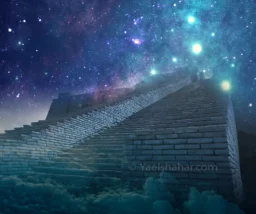
| He dreamed: A stairway was set on the ground and its top reached to the sky, and messengers of God were going up and down on it.
And the Eternal stood over it and He said, “I am the Eternal, the God of your father Avraham and the God of Yitzhak. The ground on which you are lying I will give to you and to your offspring.” |
וַֽיַּחֲלֹ֗ם וְהִנֵּ֤ה סֻלָּם֙ מֻצָּ֣ב אַ֔רְצָה וְרֹאשׁ֖וֹ מַגִּ֣יעַ הַשָּׁמָ֑יְמָה וְהִנֵּה֙ מַלְאֲכֵ֣י אֱלֹהִ֔ים עֹלִ֥ים וְיֹרְדִ֖ים בּֽוֹ׃ וְהִנֵּ֨ה ה’ נִצָּ֣ב עָלָיו֮ וַיֹּאמַר֒ אֲנִ֣י ה’ אֱלֹהֵי֙ אַבְרָהָ֣ם אָבִ֔יךָ וֵאלֹהֵ֖י יִצְחָ֑ק הָאָ֗רֶץ אֲשֶׁ֤ר אַתָּה֙ שֹׁכֵ֣ב עָלֶ֔יהָ לְךָ֥ אֶתְּנֶ֖נָּה וּלְזַרְעֶֽךָ׃ |
The story of Yaakov’s dream is one of the many narratives in the Torah that appear to engage in dialogue with other stories. Earlier in the Torah (B’reishit 11:4), we are told how men set out to “make a name” for themselves. They would build a city and a tower—a ziggurat—with its top in the heavens.
In ancient Sumeria such structures served as observatories, and were used to glean useful knowledge of the seasons, and bogus knowledge from astrology. It was the way of such knowledge to remain secret, the property of the elite, the “men of name”, who would use it to reinforce their power over those not in the know. The name of this notorious city was Bab-El, meaning “the Gateway to God”. The name of the tower signifies its purpose: to boldly bridge the gap between human and the divine and wrest the secrets of the heavens.
Meeting God in the wilderness
But the true encounter with the divine cannot be forced. In our parashah, Yaakov is offered his first such encounter. This vision comes to him when he is at his most vulnerable—alone, at night, in a strange place, far from home and fleeing his brother, asleep and helpless to defend himself even against dreams.
This is the place from which Yaakov will henceforth encounter the God of his Fathers. His next contact with God will be when he is desperate to extricate himself from a position of near slavery with his father-in-law, Lavan. And again, when he is left alone at the Yabbok crossing, then too, at night. And once more when he faces the possibility of war, his sons having carried out a massacre at Sh’chem, defiling everything that Yaakov has struggled to achieve and preserve of his grandfather Avraham’s ways. And last of all, when Yaakov faces the uncertain future in Egypt, on the cusp of history, between a free family and an enslaved nation. Always on the cusp. Always in-between.
Yaakov encounters God in a state of vulnerability, a state of uncertainty, because it is uncertainty that clears the way for us to accept the miracle of the encounter. While the tower builders constituted a single unified society bent on wresting the secrets of the heavens, Yaakov is one man, alone in a stony land, suspended between a painful past and an uncertain future.
And so, with a stone for a pillow, Yaakov dreams of a Sulam—a staircase or ziggurat, the term could mean either—between heaven and earth. He sees the messengers of God traversing the chasm, linking the transcendent heavens with the solid earth.
And God standing over it. Or over him. Again, the term is ambiguous. Is God far away, at the top of the structure, in heaven? Or is He nearby, standing over Yaakov’s sleeping form. Remote and transcendent? Or nearby and immanent? We struggle to bridge the gap, uncertain of what it is we see.
Upon awakening, Yaakov is moved to say, “How awesome is this place! This is none other than the house of God (Beit El), and that is the gateway to heaven.”
The unshakeable certainty of unified belief
The gateway to heaven leads through doubt, uncertainty, and utmost vulnerability. Is it any wonder then, that the tower builders failed in their attempts to build Bab-El, a “Gateway to God”? Their strength was their weakness. United in their goal, they had disparate reasons and longings. In the end, their unity was revealed to be an illusion by God’s fragmentation of their singular language.
“Every word that issued from the mouth of the Almighty [at Sinai] was fragmented into seventy languages,” says Rabbi Yochanan. (B. Shabbat 88b) Why seventy languages? Because each language represents a unique point of view, a worldview different from all others.[1] Absolute truth is unreachable by any one human mind. Every human being represents but one aspect of a greater truth, and only in combination can these fragmented truths approach a greater whole. Only the combined weight of all human truths can approach the One Divine truth. Thus the seventy languages of humanity are met by the One voice of God.
But the corollary is that when we rely on one opinion only—our own or someone else’s—and believe that we have the whole truth in our hands we arrogate to ourselves a position of Divine knowledge. Reliance on a false truth is bad enough; believing that the false truth is absolute is far worse. Or, in the words of modern philosopher of science:
The characteristic of all fundamentalism is that it has found absolute certainty…a certainty of the person who has finally found a solid rock to stand upon which, unlike other rocks, is “solid all the way down.” Fundamentalism, however is a terminal form of human consciousness in which development is stopped, eliminating the uncertainty and risk that real growth entails.”[2]
The tower builders represent the same type of fundamentalism—of unshakeable belief in the justice of their cause—that we see in the jihadis of our own day. They were shown the impossibility of approaching God via the unshakeable certainty of a single unified viewpoint. Their certainties were replaced by the vulnerability of fragmented knowledge.
In fact, they were shown the true nature of all human knowledge. Truth (capital T) is in heaven, and is the domain of the transcendent; human truth (small t) is immanent, bound to the created world. For this reason, the Talmud glorifies competing views as facets of an overall truth, which can be approached only via the inclusion of disparate viewpoints. “These and these are the words of the living God”—not one or another, but the combination of all.
The dreaming Yaakov, resting on the rock of uncertainty, discovers a deep truth. His vision comes at a liminal time, between home and the unknown, between hope and danger, between night and day. And so it comes as no surprise that his is a liminal vision, between immanent and transcendent. For this is precisely what “kedusha” (holiness) is; it is the interface between the transcendent God and the immanent manifestation of the Divine in the created world. Thus, Yaakov encounters God in that liminal state of neither here nor there, bereft of the comforts of home, family, and even name.
It is on the rocky road of risk and uncertainty that we encounter God, between the immanent and the transcendent.
Notes:
[1] See Yoram Hazony, God and Politics in Esther, p. 37 (Back to text)
[2] Heinz Pagels, The Dreams of Reason. p. 328. (Back to text)

Yael Shahar
After an adventurous and unattributable career in security and intelligence, Yael Shahar now divides her time between writing about Jewish philosophy and learning Talmud with anyone who will sit still long enough. She is the author of Returning, a remarkable true story of spiritual resilience. Her writing on Jewish history and philosophy can be found at www.yaelshahar.com.