Announcing the Cardozo Academy Writers Guild!
Due to the war in Israel and other circumstances, I have asked Yael Shahar, the well-known author of Returning, and member of our Think Tank and Writer’s Guild to share with me the penning of the weekly Thoughts to Ponder Series. These essays are written in the spirit of the Cardozo Academy and with my full approval.
I thank her very much!
Nathan Lopes Cardozo
“What is Hanukkah?” Ask this question of any Jewish schoolchild and you’ll learn that the holiday commemorates the victory of the Hasmonean Jews over the Greek empire, whose rulers attempted to suppress Jewish worship.
The Hasmonean uprising was a turning point in Jewish history: for the first time since the Babylonian exile, the Jews fought a regional power and won. That victory led to the re-establishment of a politically independent Jewish commonwealth under a Jewish monarch for the first time since the destruction of the First Temple.[1]
And yet, if we search in the Babylonian Talmud for an answer to the question “What is Hanukkah?” we don’t find the answer we expect. Instead of a history lesson, we get a colorful story of how when the victorious Maccabees rededicated the Temple, the sole remaining jar of ritually pure olive oil for the menorah sufficed for eight days, until more could be brought[2]. It’s a nice story, but not particularly satisfying. What about the military victory over vastly superior forces? What about the resurrection of an independent Jewish state? Tell us about the real miracles—the ones that changed the course of history![3]
Nor was it only the Talmud that was mysteriously reticent about the Hasmonean victory. The earlier Sages went to great lengths to obscure the underlying political and military basis of the holiday. The books of the Maccabees were left out of the Jewish canon altogether.
Why this seeming censorship? Why was the Hannukah story passed down to us in such a strange way? It turns out that what the sages left out—and why—has lessons for us in our current reality.
A clash of civilizations
While the Seleucid Empire against which the Maccabees fought was a civilization in decline, Judea had never really recovered from the Babylonian exile some 400 years previously. The period between the return from Babylon and the Hasmonean kingdom is the Jewish equivalent of “the Dark Ages”. We have very little written or even oral history from this period: few names of sages or leaders. And when scholarship finally reemerges out of the murk of history, the leading Jewish sages have Greek names!
The parts of this story that the Talmud left out make for sordid reading: a prolonged and ugly civil war, corruption, economic breakdown… all the ills of a failed Jewish state. Schisms and enmities within the society were rife, and easily exploited by the Seleucid authorities:
In 171 BCE the king [Antiochus] dismissed Jason [the corrupt High Priest], crowning the treasurer of the Temple, Menelaus, in his stead. The book of Maccabees even relates the price that Menelaus paid for his new job – three hundred coins more than Jason had offered.[4]
Thus we have a clash of two fragmented cultures, each struggling for identity. While the Seleucid Empire shone in the reflected light of a brilliant but dying Hellenistic culture, Jewish society was struggling to relight the fires of its own cultural identity after the Babylonian exile.
A lesson not learned
But if there are historical lessons to be learned from this sordid story, why did the sages of the Talmud not spell them out?
It’s been suggested that the silence of the Talmud and Mishna about Jewish victories is primarily due to fear of the non-Jewish authorities. And yet, that’s clearly not the whole story; it may be that there’s a deeper lesson in the Talmudic sages’ silence. The failing empire of Antiochus provided valuable practice for the far more serious threat of Rome—both politically and religiously. Had the Hasmonean dynasty not descended into corruption and sectarian strife, the clash with Rome might have had a different ending.
Unfortunately, the lessons weren’t learned in time. The Maccabees themselves acted to abolish checks and balances on their rule by taking upon themselves the positions of both king and priesthood.[5] Meanwhile, the civil war over the Hasmonean succession led one faction to invite Roman intervention, ultimately leading to the Roman conquest of Judea.
It may be that this is exactly the issue that the sages of the Talmud were trying to emphasize. They understood that the political and military fight, though important, was not the heart of the matter. What mattered was that Jewish values themselves should be so well internalized that no wedge could be driven between the disparate sectors of society.
National cohesiveness is just as important in peacetime as it is in wartime. Military victory, no matter how hard-won, will not be enough to hold a society together if the heart of the nation is divided.
Had Jewish society been stronger in its identity and national ethos, its clash with Hellenism would have been far less destructive of Judean society; Jewish cultural elites would have been able to take from the foreign culture what could easily be woven into the fabric of Jewish tradition, and calmly rejected the rest.
The light that survived
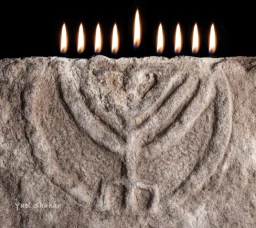
This lesson is subtly woven into the observance of Hanukkah as it has been handed down to us. The hanukkiah is not lit in the private space of the home, nor is it traditionally lit in purely public spaces; rather, it is set out on the threshold of the home, marking the dividing line between private and public space, between the light streaming outward from the home and the light coming in from outside.
And really, this is what the holiday is all about: defining distinctions between what is inside and what is outside—what values we assimilate from other cultures and what is best left outside, what customs and worldviews uniquely define us, and what traditions and practices we can let go of in light of new circumstances. In the end, our light meets the lights of other cultures, and yet remains itself.
And so we come to the secret of the answer given by the Babylonian Talmud. Pressed to explain what Hanukkah was all about, the sages said nothing about the military and political victories, but instead brought forward a beautiful midrash that sums up the true miracle of that time: For all that we were dragged into a brutal war of brother against brother, of the settling of scores and the collapse of government; for all that we had so forgotten our own traditions that much had to be later recreated by sages whose very names were no longer Jewish—still, our light did not go out. We came through one of the darkest periods of Jewish history with our inner fires still burning, ready to rebuild.
May the lights of Hanukkah remind us that together we can keep our light burning through the darkest times.
Notes:
[1] Some modern scholars also see this period as the first time when archaeological evidence supports widespread practice of many modern features of Jewish law among ordinary Judeans. See Yonatan Adler, The Origins of Judaism: An Archaeological-Historical Reappraisal (Yale University Press, 2022).
[2] Shabbat 21b. Elsewhere the Babylonian Talmud discusses the failures of Maccabean rule, but very little is reported about the victory that led to the celebration of Hanukkah.
[3] Later, a reference to the historical events was added to the Jewish prayer book, in the form of the “al HaNissim” prayer. This prayer giving thanks for the miracles during the time of the Maccabees is taken from the siddur of Rav Amram Gaon (who died 875 CE) and the siddur of Rav Sa’adiah Gaon (died in 942 CE). The prayer is also mentioned by Rav Achai (Sheiltot d’Rav Achai Gaon, Vayishlach, 26:1), who lived around 750 CE. The fact that versions of this prayer were circulating at the time the Babylonian Talmud was completed only heightens the contrast to the Bavli’s answer to the question: “What is Hanukkah?”.
[4] Rav Benyamin Lau, The Sages, Vol. I, Maggid, 2010. P. 88.
[5] The concentration of religious, political, and military power in the hands of the Hasmonean rulers is decried elsewhere in the Talmud. What might have been a temporary necessity led to the corruption that contributed to the Roman conquest.

Yael Shahar
After an adventurous and unattributable career in security and intelligence, Yael Shahar now divides her time between writing about Jewish philosophy and learning Talmud with anyone who will sit still long enough. She is the author of Returning, a remarkable true story of spiritual resilience. Her writing on Jewish history and philosophy can be found at www.yaelshahar.com.