“Go forth from your land, your birthplace, and your father’s house… and I will bless you… and all the families of the earth shall be blessed through you.” (Bereshit 12:1–3)
Avraham’s first calling is not a command of comfort but of disruption. True monotheism, the Torah tells us, begins not with serenity, but with a radical severance. To enter a covenant with the imageless, undefined, and unnameable God is to abandon old securities and the inherited world of assumptions. One must leave one’s familiar land, one’s emotional birthplace, and even one’s mental home. Faith does not begin in continuity, but in rupture.
The break with the past
Authentic belief requires an inner emigration — a bold refusal to remain imprisoned by habit, culture, or collective sentiment. The religious life is not an extension of the past but a revolution against spiritual complacency. God’s call to Avraham is therefore the most radical upheaval imaginable, and yet — and this is the paradox — it demands that one remain deeply oneself.
Judaism rejects inherited religiosity as a sufficient foundation. You cannot inherit God, you must discover Him yourself. Only then can you understand that He was also the God of your parents and your past. The order cannot be reversed. First comes personal discovery, then ancestral continuity. As the Israelites would later sing: “This is my God and I will exalt Him — the God of my father, and I will glorify Him” (Shemot 15:2). First my God — then the God of my father.
There is no shortcut to this encounter. God is not a philosophical deduction or a theological axiom. Avraham does not arrive at God through syllogisms but through an existential event — a revelation that strikes like lightning, making the soul tremble.
Yet many religious people, then and now, construct systems of protection — spiritual lightning rods — designed to deflect the shock of the Divine. They prefer predictability over encounter, routine over vulnerability. In doing so, they lose focus. Religion becomes insulation rather than ignition.
Faith, risk, and the necessity of doubt
Who, then, can attain genuine faith? Only those willing to risk themselves. Avraham is not merely a believer; he is a pioneer, ready to walk into the unknown.
Ironically, the search for God must begin not with certitude but with honest doubt — even atheism of the highest kind: the refusal to accept a God unencountered. If God is truly God, He must be sought in freedom, not inherited passively. Thus, doubt becomes the cradle of faith, the necessary precondition for discovery; to find Him, He must first be absent. The Kotzker Rebbe was right: the search for God is a kind of warfare, because the human tendency toward comfort constantly resists transformation.
The greatest proof of religious decay today is the staggering number of people who believe in the identical clichés. Mass-produced religiosity is the death of faith. Where everyone thinks the same, no one is thinking. Judaism never asked us to become echoes of one another. To be religious is to free oneself from the crowd, to ignore applause, and to refuse the borrowed thoughts of others.
True monotheism demands creative individualism. Only a person who has stood alone, like Avraham, can be a source of blessing to others. Otherwise, religion devolves into mimicry, and faith hardens into ideology.
To be a blessing
The purpose of leaving home is not escape, but mission. The Jew is commanded not to blend into the crowd but to challenge it — to stir, provoke, invite, elevate. “And you shall be a blessing.” The religious life is not self-absorption but active contribution.
To believe is therefore to live dangerously — to stand apart, to question, to seek, to rebel against false comforts, and to blaze a trail of holiness in a world that prefers mediocrity. Avraham teaches us that to walk with God is to walk alone — and thereby to transform humanity.
Avraham’s journey is the archetype of all genuine religious existence. Leave. Search. Struggle. Discover. Influence. There can be no encounter with God without departure, no faith without risk, and no blessing without individuality.
To believe is not to arrive. It is to begin — again and again.

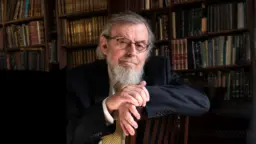
Rabbi Nathan Lopes Cardozo
Rabbi Dr. Nathan Lopes Cardozo is the Founder and Dean of the David Cardozo Academy and the Bet Midrash of Avraham Avinu in Jerusalem. A sought-after lecturer on the international stage for both Jewish and non-Jewish audiences, Rabbi Cardozo is the author of 13 books and numerous articles in both English and Hebrew. He heads a Think Tank focused on finding new Halachic and philosophical approaches to dealing with the crisis of religion and identity amongst Jews and the Jewish State of Israel. Hailing from the Netherlands, Rabbi Cardozo is known for his original and often fearlessly controversial insights into Judaism. His ideas are widely debated on an international level on social media, blogs, books and other forums.