“For this commandment that I command you today is not too wondrous for you, nor is it far away. It is not in heaven… nor is it beyond the sea… but the word is very near to you, in your mouth and in your heart, to do it.”
Devarim 30:11–14
The Torah is not somewhere apart from us. In fact, it exists within us—inscribed in our consciousness, woven into our very being. That is why living according to the Torah so often feels like a homecoming: we are acting in accordance with what we were fashioned for from birth. And yet, if it is so natural, why is it so difficult?
Bad Maps and Blurred Vision
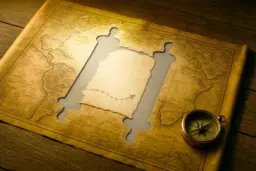
The answer begins with our maps. The philosopher E. F. Schumacher once recounted arriving in Leningrad, unable to locate himself because the map in his hand omitted the churches that stood plainly before his eyes. “We don’t show churches on our maps,” he was told. The problem, he realized, was not his eyesight but the map itself.[1]
So it is with life: we are handed (and often prefer) maps that leave out the landmarks that matter most. Schools and universities—sometimes even very prestigious ones—can habituate us to inferior maps. And we, too, collude in this omission because precise maps might confront us with truths we would rather not see.
Fear of the True Map
Fear is the quiet editor of our inner atlas. What if I discover that my set patterns are wrong? What if acknowledging this would obligate me to change my life? We pacify ourselves to believe it is better to avoid changing our lives, keeping the possibility safely locked away in the subconscious, leaving our routines undisturbed
At the Limmud conferences I attended—in England, the United States, the Netherlands, Germany, and beyond—thousands gathered each day for a week of learning on Judaism, philosophy, Israel, politics, and culture. Before giving my own talks, I would sit and listen to those who disagreed with me: committed Jewish atheists, communists, and other so-called “heretics”—several are friends to this day.
Limmud was a marvelous marketplace of ideas. I loved these conferences. They broadened my perspectives, opened me up to learn and think about new approaches and ideas. After all, we owe nearly all our growth in knowledge and achievements not to those who agree with us but to those with whom we differ.
In earlier, healthier times we welcomed dissent because it refined us. Today we often flatten the world into agreeable certainties, trampling difference while congratulating ourselves on being avant‑garde. As a result, mediocrity abounds. We choose maps that hide our opportunities to change so that we can avoid the burden of choosing differently.
Franklin D. Roosevelt warned: “The only thing we have to fear is fear itself.”[2] Greatness is not the absence of fear but the triumph over it. Yet many of us choose comfort over courage; we cannot choose both. To go against the flow requires developing a backbone that takes real effort to achieve. Instead, we prefer to engage in small talk and easy slogans which replace the labor of honest thought. We even make choices without knowing what we are choosing among—mistaking ignorance for insight.
Choosing with Open Eyes
Moshe’s teaching in Nitzavim is that truth is closer than we want to admit. We tell ourselves that meaning lies in heaven or across the sea—anywhere but here. But the Torah insists: the word is very near, already on our lips and in our hearts. The Jewish tradition contends that living by the Torah is the natural path for the Jew; it is the road to authenticity. Still, both the non‑observant and the observant can resist. The former may fear being commanded; the latter may hide behind religious convention, fearing to acknowledge that which may be unsettling. Both cling to maps that flatter and delude us.
Eventually the illusion fails: “Let none among you bless himself in his heart, saying, ‘I shall have peace, though I walk in the stubbornness of my heart.’”[3] We can postpone the reckoning, but we cannot escape it. The question is whether we will reach for the truer map now—the one that names what we already sense—and accept it with the courage it demands.
A Text‑Person, Not a Textbook
What does faith mean? It does not mean inherited slogans and unexamined loyalties. Faith must be earned and discovered anew. We must be pioneers, not mere followers, and we must even challenge our own originality so it may be refined. Rabbi Abraham Joshua Heschel put it simply: “We can never leave behind our concern in the safe‑deposit of opinions… We must keep our own amazement, our own eagerness alive.”[4] The task of our universities and our yeshivot, then, is not only to produce learned people with successful careers but to cultivate “text‑persons”—living Sifrei Torah—men and women whose lives embody what the texts teach.
Remembering the Forgotten Land
The Torah is not a terra incognita; it is a land we have allowed ourselves to forget. Even the “religious” can become functional atheists—indifferent to the mystery of life, deaf to the awe that true religion requires. Nitzavim summons us to remember, to recover the map already inscribed within us, and to act on it. The word is near. The only real distance is the fear we permit to stand in the way.
Notes
[1] E. F. Schumacher, A Guide for the Perplexed (New York: Harper & Row, 1977), ch. 1, “The Map.”
[2] Franklin D. Roosevelt, First Inaugural Address, March 4, 1933.
[3] Devarim (Deuteronomy) 29:18 (some editions count 29:19).
[4] Abraham Joshua Heschel, Man Is Not Alone (New York: Farrar, Straus and Young, 1951), p. 14.

Rabbi Nathan Lopes Cardozo
Rabbi Dr. Nathan Lopes Cardozo is the Founder and Dean of the David Cardozo Academy and the Bet Midrash of Avraham Avinu in Jerusalem. A sought-after lecturer on the international stage for both Jewish and non-Jewish audiences, Rabbi Cardozo is the author of 13 books and numerous articles in both English and Hebrew. He heads a Think Tank focused on finding new Halachic and philosophical approaches to dealing with the crisis of religion and identity amongst Jews and the Jewish State of Israel. Hailing from the Netherlands, Rabbi Cardozo is known for his original and often fearlessly controversial insights into Judaism. His ideas are widely debated on an international level on social media, blogs, books and other forums.