ואתה הקרב אליך את־אהרן אחיך ואת־בניו אתו מתוך בני ישראל לכהנו־לי אהרן נדב ואביהוא אלעזר ואיתמר בני אהרן
Shemot 28:1
You shall bring forward your brother Aaron, with his sons, from among the Israelites, to serve Me as priests: Aaron, Nadab and Abihu, Eleazar and Ithamar, the sons of Aaron.
One of the great blessings in life, which many of us benefit from, is that we often do not know what we have missed out on. Ignoti nulla cupido, “There is no desire for what is not known,” said Ovid in his Ars Amatoria (III. 397). This may sound rather strange, but when we examine our own lives, we see that many people can be satisfied with their material standard because they do not fully realize, or refuse to realize, that they could have had more.
Or, in the words of Shakespeare:
The Jewel that we find we stoop and take’t
Because we see it, but what we do not see
We tread upon, and never think of it.
(Measure for Measure, Act II, Scene 1.)
Today we have convinced ourselves that we cannot survive without electricity, refrigerators, cars and airplanes. We are therefore astonished when we realize that our forefathers lived their lives without any of these “necessities,” even though they belonged to the “upper class.” We are even more surprised to learn that they were often happier than we are. They neither possessed nor missed these belongings for the simple reason that such things did not exist.
Julius Caesar and the Menhirs
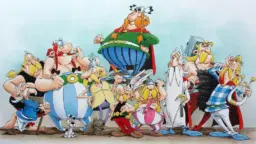
Two famous cartoonists, R. Goscinny and A. Uderzoin created a series of hilarious cartoons, “Asterix and Obelix” — a parody on modern society which no doubt is well known to our European readers. On edition, “Obelix and Co.” is about a time when the great emperor, Julius Caesar, was looking for ways to defeat the invincible Gauls. The latter lived in a small town in the north of what was later called France. This small, but totally independent village is the hometown of the heroes of Asterix and Obelix, who frequently poke fun at the Romans. The Roman army is constantly defeated by the Gauls due to the fact that the latter possess a miraculous potion invented and brewed by the wise Druid, Getafix, which gives the drinker superhuman strength. This is obviously a thorn in the side of Caesar. In a meeting of Caesar’s inner cabinet, one unsympathetic figure suggests that they should try to make the Gauls so completely addicted to money that their interest in warfare and independence will dissipate.
Following this advice, Caesar starts buying thousands of menhirs, massive, useless stones, from a company belonging to the Gauls. This company called “Obelix and Co” is run by the Gaul, Obelix. The plan is that Obelix will be seduced by the money he receives, and will thus be forced to employ all his fellow citizens so as to meet the demands of fulfilling Caesar’s order. In this way, their attention will be diverted away from warfare, and Caesar will have his way and finally defeat them.
After having acquired a large quantity of these stones, Caesar’s treasury is entirely depleted, and he is forced to sell these menhirs to his own people before his empire becomes bankrupt. Convincing his citizens to buy these menhirs is, however, a major headache. How to convince them of the absolute necessity of possessing these worthless stones?
A major advertisement campaign is launched, and slowly, millions of people start buying these useless stones. Prices rise to absurd levels, and the entire Roman empire is convinced that life without these stones is not worth living. Some even contemplate suicide for the lack of them. A whole country is now funded and driven by enormous pieces of stone which have no other function but to get in the way.
While this story is meant to be comical, its message is most serious. Almost nothing will be missed unless it has once been tasted. We feel deprived of something only once we are aware of its existence, or when we have experienced it even for a very short period of time.
Cartoons are a remarkably effective means of communicating profound ideas. While we do not wish to equate the Torah with cartoons, our sages did teach us that God created the world in such a way that spiritual circumstances are represented in the secular realm. In this way, the profane holds a spark of that which takes place in the world of holiness.
Ignoti nulla cupido (there is no desire for what is unknown)
When Moshe is told to appoint Aharon and his sons to the priesthood in the Mishkan, he is told by God: “And you bring near to yourself your brother Aaron, and his sons with him, from among the children of Israel to serve Me . . . ”[1] Most unusual is the expression “bring near to you” (hakrev). We would have expected that the text would read “you shall appoint Aharon and his sons.”
Ohr Ha-Chaim, the great eighteenth-century commentator on the Torah, reminds us of the fact that it was originally God’s plan to have Moshe himself be the high priest. But since Moshe refused to respond to God’s request at the Burning Bush,[2] to take full responsibility as leader and redeemer of the people of Israel, the task to become the high priest (in addition to being the leader) was denied to him and transferred to his brother Aharon.[3]
Most surprising, however, is the fact that Moshe did become the high priest, albeit for a short time. The Torah informs us that for seven days Moshe functioned as the high priest in the newly built Mishkan.[4] Only thenwasMoshe asked to pass the priesthood on to Aharon, his brother. This requires an explanation. Why was the priesthood not immediately given to Aharon, as was already decided at the time of the Burning Bush? Ohr Ha-Chaim provides us with a powerful answer. He claims that God decided on this procedure to remind Moshe of what he had lost when he hesitated in complying with His request at the Burning Bush. By making Moshe a high priest for only a few days, God gave him a taste of the greatness, dignity and merit of this office.
It is for this reason that he was asked to make sure that Aharon and his sons “come near” (“hakrev”) to him to become the new priests. The word “hakrev” has a double meaning, says Ohr Ha-Chaim. It means “to bring near” but it is also related to the word “korban.” Moshe was asked by God to bring a sacrifice as a kaparah, an atonement, for his earlier refusal, by giving the priesthood over to his brother after one week of office. He would not have known what he had lost had he not first tasted what it meant to be a high priest. This, says Ohr Ha-Chaim, is the great sacrifice which Moshe brought.
It should be understood that the sacrifice that Moshe had to undergo was not necessarily a punishment for his failure to appreciate what was offered to him, but was a message to future generations that a person has to learn to carefully contemplate and appreciate what is offered to him before he rejects it.
Only when one recognizes the extent of one’s loss, will one appreciate what one could have had. Indeed, “Ignoti nulla cupido.”
Questions to Ponder from the DCA Think Tank:
In In Memoriam, Alfred Lord Tennyson writes that, “‘Tis better to have loved and lost than never to have loved at all.” If that is true, then God would have been granting Moshe a favor by allowing him to serve for seven days before taking that privilege away. The same could be said about showing Moshe the land of Israel from Mount Nevo before Moshe died. Do you agree that it is better to have loved and lost?
The People of Israel have loved and lost enormously. We still mourn the loss of the Temple and the loss of prophecy, and we struggle to love and be faithful to God without these means of communication with our Beloved. It has been 2,000 years. How long can love compensate for loss? How long can one sustain love in the face of loss?
Shakespeare asks, “To be or not to be?” through the mouth of Hamlet. The Gemara asks the same question in Eruvin 13b where it describes Beit Shammai and Beit Hillel’s debate about whether it would have been better for humans never to have been born. After two and a half years, they conclude that Beit Shammai is right, and that it is better not to be born. Does this imply that it is not better to love and to lose? Or, at least, that life is likely to contain more loss than the amount of love required to compensate for the loss? (Or are the issues unrelated? Is the passage not talking about suffering, but rather making a dry calculation about the likelihood a person has of sinning too much to make life worthwhile? If that is the case, as some claim, why would God create people when it is likely that they will sin more than makes life worthwhile?!)
Notes
[1] Shemot 28:1.
[2] Shemot 3.
[3] Ohr Ha-Chaim on Shemot 28:1. See Shemot Rabba, Vilna ed., 3:17.
[4] Shemot 29.

Rabbi Nathan Lopes Cardozo
Rabbi Dr. Nathan Lopes Cardozo is the Founder and Dean of the David Cardozo Academy and the Bet Midrash of Avraham Avinu in Jerusalem. A sought-after lecturer on the international stage for both Jewish and non-Jewish audiences, Rabbi Cardozo is the author of 13 books and numerous articles in both English and Hebrew. He heads a Think Tank focused on finding new Halachic and philosophical approaches to dealing with the crisis of religion and identity amongst Jews and the Jewish State of Israel. Hailing from the Netherlands, Rabbi Cardozo is known for his original and often fearlessly controversial insights into Judaism. His ideas are widely debated on an international level on social media, blogs, books and other forums.