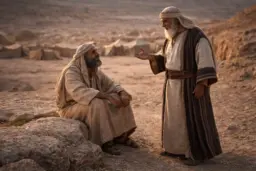
When Moses’ father-in-law saw what he was doing to the people, he said, “What is this thing that you are doing to the people? Why do you sit by yourself, while all the people stand before you from morning till evening?” Shemot 18:14
Rabbi Samson Raphael Hirsch, one of the great Jewish leaders and thinkers of modern times, asks us to take notice of a strange incident that occurred in the days of Moshe. After Moshe left Egypt with a multitude of people, his father-in-law, Yitro, criticized him for the way he was arbitrating disputes among the Israelites:
Why are you sitting alone and letting all the people stand around you from morning until evening?” Moshe replied to his father-in-law: “Because the people come to me to seek God. Whenever they have a problem, they come to me, and I judge between each man and his neighbor, and I teach God’s decrees and laws.” And Moshe’s father-in-law said to him: “What you are doing is not good. You are going to wear yourself out, along with this nation that is with you.[1]
Yitro then suggested that Moshe reform the existing legal system so that only the major problems would be brought to his personal attention while minor disputes would be decided upon by a large number of wise people who would assist him. “It will make things easier for you, and they will share the burden. Moshe took his father-in-law’s advice and did all that he said.”[2]
Moshe’s Exhaustion
Rabbi Hirsch poses a very simple question: Could Moshe not have determined this on his own? Did he not realize that he was exhausting himself and that it would not be long before he could no longer cope with the situation? One does not have to be a genius to recognize the problem. Moreover, Yitro’s suggested solution is basically a simple one and does not require any extensive judicial knowledge. So why did Moshe, who possessed great wisdom, not think of this himself?
Before studying Rabbi Hirsch’s answer, we would like to pose another question. We are informed that at the end of Moshe’s life “His eyes had not dimmed and his vigor was unabated.”[3] His physical stamina was beyond average, and indeed we do not see that Moshe ever got tired (except in the case of the Jews fighting Amalek, when his hands did become heavy).[4] It is therefore strange that Moshe suddenly felt weary while judging the people. We would not have been surprised to read that Moshe told his father-in-law not to worry, since he was untroubled by fatigue and he could easily handle all those who came to see him.
Moshe, however, made no such claims. Instead, he seemed most eager to implement Yitro’s suggestion. We must therefore conclude that he did indeed feel extremely tired!
Our question, then, is obvious. Why did he suddenly feel weary? Would the man who was without food and water for forty days at the top of Mount Sinai not have been able to sit from early morning until late at night to judge the people without exhausting himself? Why did God suddenly deny him his usual, though unprecedented, stamina?
All this aside, we would suggest that God had good reason to ensure that Moshe actually maintained his strength. As the great leader and teacher of Torah, Moshe desperately needed to stay in contact with all of his people. The best way to accomplish this would be by guaranteeing that he would see them on a regular basis. Once he would no longer encounter all of them, they would become spiritually distanced from him, and he would be unable to teach them in the manner to which he was accustomed. Indeed, this seems to have happened after he implemented Yitro’s advice! So what were God’s motives in causing Moshe to suddenly feel tired?
We may now refer to Rabbi Hirsch’s observation:
Nothing is so instructive to us as this information regarding the first legal institution of the Jewish State, coming immediately before the chapter of the Law-giving. So little was Moshe in himself a legislative genius, he had so little talent for organizing that he had to learn the first elements of state organization from his father-in-law. The man who tired himself out to utter exhaustion and to whom of himself did not occur to arrange this or some other simple solution, equally beneficial to himself and his people; the man to whom it was necessary to have a Jethro [Yitro] to suggest this obvious device, that man could never have given the People constitution and Laws out of his own head, that man was only, and indeed just because of this the best and the most faithful instrument of God![5]
In other words, Moshe, in spite of his immeasurable talents and abilities, lacked basic insight into how to administer proper judicial process. God denied him this insight to prove to later generations that he could never have been a lawgiver and that the laws of the Torah were not the result of his superior mind.
Non-Jewish greatness
I would like to suggest a second reason for God’s denying Moshe his usual stamina: in order to allow a non-Jew to come forward and give him advice! The Kabbalist Rabbi Chaim Ibn Attar, known as Ohr Ha-Chaim (1696-1743), indeed alludes to this when he writes that the very reason why God caused Yitro to come and visit the camp of the Israelites was to teach the Jewish people that although the Torah is the all-encompassing repository of wisdom, gentiles, while not obligated to observe all its laws, are fundamental to its success and application.[6] There are areas in which Jews do not excel and where non-Jews are much more gifted. One such area at that time seems to have been judicial administration skills.
Judaism has never been afraid to admit that the gentile world offers much wisdom and insight. While Jews have to be a nation apart, this does not contradict the need to look beyond our own borders and benefit from the wisdom of outsiders: “The gentile world may not possess Torah, but it definitely does possess wisdom.” [7]
It is this message that God sent to His people only a short time after He had delivered them from the hands of the Egyptians. Due to their experience in the land of their slavery, they had developed such animosity for anything gentile that they became utterly convinced that mankind at large was anti-Semitic. God immediately crushed that thought and sent them a righteous gentile by the name of Yitro, to impress upon them that the non-Jewish world includes remarkable people who not only possess much wisdom but actually love the people of Israel and wish to contribute to Jewish life.
Moshe’s sudden weariness and God’s decision to deny him his usual strength is therefore highly informative. The Jews may have begun to believe that they were self-sufficient and could do it all alone. This attitude, rooted in their conviction that all gentiles are anti-Semitic and therefore not to be relied upon, could lead not only to total isolation but also to an air of Jewish arrogance contrary to God’s will. By allowing Moshe to become exhausted, God ensured that he would indeed require the wisdom of someone else — this time the wisdom of a non-Jew.
At the same time, it kept Moshe humble. By designating Yitro to be the father-in-law of the most holy Jew of all times, God made it crystal clear that He would not tolerate any racism and that a righteous gentile could ascend to the highest ranks of saintliness. Only after that message was sent were the Jews ready to enter the land and begin their life as an independent nation.
Notes:
[1] Shemot 18:14-18.
[2] Ibid. 18:22, 24.
[3] Devarim 34:7.
[4] Shemot 17:12.
[5] The Pentateuch, Exodus: trans. and explained by Samson Raphael Hirsch, rendered into English by Isaac Levy (Gateshead: Judaica Press, 1989), 247.
[6] Ohr Ha-Chaim on Shemot 18:21, beginning with the words Ve-nir’eh ki ta’am ha-davar hu.
[7] Echa Rabba, Buber ed., 2.
[8] The Jewish Observer, March 1991, p. 50. Accessible online at: http://www.atid.org
/upload/Administrativa/WebFiles/rkotler.pdf.
[9] See Mechilta on Shemot 18:24; and the commentary of the Ohr ha-Chaim on Bamidbar 10:30.
Questions to Ponder from the DCA Think Tank:
- “ . . . that man could never have given a constitution and Laws out of his own head, that man was only and indeed just because of this the best and the most faithful instrument of God.”
What does Samson Raphael Hirsch mean by this? What kind of leader does he suggest God wants? Do you agree with his interpretation? Why or why not? Does this make Moshe a stronger or weaker leader in your eyes? - “Moshe, in spite of his immeasurable talents and abilities, lacked basic insight into how to administer proper judicial process.” The Jewish world is divided as to the appropriate lens through which to view biblical heroes. One approach, held for example by Rabbi Aaron Kotler of Lakewood, holds them to be “the most luminous, loftiest and purest personalities”[8] The other approach is to engage with their flaws and shadow side, arguing that in doing so we are following the Torah’s lead. A discussion of Moshe, the ultimate prophet, is likely to be particularly sensitive ground. Does Rabbi Hirsch’s statement about Moshe trouble you? If not, what type of statements would?
- Rabbi Cardozo argues that a central lesson here is that the outside world is to be embraced, and has much to teach us. But Judaism also contains significant warnings against embracing foreign cultures. Are there limits to what Jews should learn from the non-Jewish world? If so, what are they?
- Though the mainstream view is that Yitro is a convert, one Rabbinic opinion seems to suggest that, after a time spent in the desert with Moshe, Yitro went back to his gods and never converted.[9]
Does this change how you view him, or the significance of his advice to Moshe? Do you find the idea that he did not join the Israelite people disappointing? Why? Why might the tradition be invested specifically in the notion of Yitro becoming a Jew, or alternatively in his not becoming one? - Yitro is an essential aid and mentor to Moshe. Without him, Moshe’s ability to lead would have degenerated, conceivably greatly impacting Jewish history. Rabbi Cardozo suggests that one of the reasons Yitro was chosen for this role was because he was an outsider. But he was, in addition, Moshe’s father-in-law. Is it significant that it was a relative who was the one to advise Moshe? What might this tell us about family? In your life, who puts you in your place, telling you essential, difficult-to-hear home truths and offering practical advice — or, at least, who do you wish would do so? A family member? An outsider? A friend? A mentor? Or no one.

Rabbi Nathan Lopes Cardozo
Rabbi Dr. Nathan Lopes Cardozo is the Founder and Dean of the David Cardozo Academy and the Bet Midrash of Avraham Avinu in Jerusalem. A sought-after lecturer on the international stage for both Jewish and non-Jewish audiences, Rabbi Cardozo is the author of 13 books and numerous articles in both English and Hebrew. He heads a Think Tank focused on finding new Halachic and philosophical approaches to dealing with the crisis of religion and identity amongst Jews and the Jewish State of Israel. Hailing from the Netherlands, Rabbi Cardozo is known for his original and often fearlessly controversial insights into Judaism. His ideas are widely debated on an international level on social media, blogs, books and other forums.