While the Israelites wandered in silence, convinced that God had abandoned them, their enemies were unknowingly blessing them under Divine compulsion. What does this hidden drama reveal about faith, paradox, and God’s presence in the darkest chapters of history?
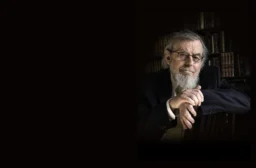
Rabbi Cardozo, guest presenter on The Philosophical Jew
In this thought-provoking interview on the Philosophical Jew podcast, Rabbi Nathan Lopes Cardozo, delves into the dynamic nature of Halakha and the importance of spiritual authenticity in modern Judaism. Drawing from his work Jewish Law as Rebellion, Rabbi Cardozo challenges us to view Torah not as a static legal code but as a living, breathing call to moral and spiritual revolution.
Zionism will not hold if it is not deeply rooted in Judaism. But this Judaism must radiate grandeur. In exile, Judaism was strangled and reduced chiefly to the private domain. It could not prove its enormous potential as an all-compassing ethos that included all dimensions of human existence. It is the task of great teachers, Jewish thinkers and Halachic authorities to show the way back to this ethos.
Everything around us, and everything that makes us human, should awaken in us feelings of awe, of amazement. How can our brains, purely physical mechanisms, produce mental thoughts? We may be able to apprehend but how can we comprehend all this? It is completely mysterious. In Rabbi Heschel’s words: “We hear a perpetual murmur from the waves beyond the shore”. This the beginning of all happiness—to stand in surprise and being overtaken by awe. Why then do we slip into routine and take life for granted?
Western civilization has a very specific approach to life—one that is highly pragmatic. Matters are seen from a purely utilitarian point of view. Actions are measured by the standard of whether they achieve results. And yet, as Rabbi Abraham Joshua Heschel so astutely observed, what smites us with total amazement is not what we grasp and are able to convey, but that what lies beyond our grasp—not the quantitative aspect of nature, but something qualitative. Everything is more than the sum total of its parts. We are aware of something that is entirely beyond description or comprehension.
The biggest questions about life are unanswerable. Not one philosopher has ever given a satisfactory answer to these questions; neither has science or any other form of human knowledge. Logic and science tell us about the “what” and the “how” but not about the “why”. They fall flat when it comes to the “ultimate” questions. But if this is the case, why ask questions which are unanswerable?
About nine years ago, the 929 project was launched. Similar to (but much easier than) Daf Yomi, individuals study one chapter of Tanach a day five days a week, completing the entire cycle in 929 days (3.5 years). Those engaged in it are currently learning the Book of Job, which offers us wisdom in these trying times.
With the terrible pogrom which took place in my hometown, Amsterdam, and the ongoing Anti-Semitism in Europe, the United States, and indeed worldwide, it is time to give proper attention to one of the great mistakes of modern Jewish history. This is the myth that if Jews would only “normalize” themselves, anti-Semitism would come to an end. This constantly repeated mantra has proven to be entirely wrong and in fact, dangerous.
Ido Pachter’s Introduction to Jewish Law as Rebellion – Part 4
When I decided to study at the ultra-orthodox Gateshead Yeshiva, I learned that Judaism consists of a world view of tremendous depth, which is expressed in deeds and rituals that penetrate the deepest dimensions of the human being. I discovered Judaism in a different way than my fellow Yeshiva students did. They had grown up within Judaism, and thus were not able to see it from the outside as I did. They were so used to the splendor of Judaism that they were blinded by it and so no longer could they perceive it. At a later stage of my life, I myself fell victim to this same problem. I realized that I had lost my earlier fascination and had to start all over again. In this essay, Rabbi Pachter explains how I tried to do this.
Ido Pachter’s Introduction to Jewish Law as Rebellion – Part 1
Rabbi Dr. Ido Pachter has provided an intriguing introduction to his Hebrew translation of my book: Jewish Law as Rebellion, A Plea for Religious Authenticity and Halachic Courage (Urim Publication, 2018). The book was published by Yediot Acharonot in May of this year under the title: ההלכה כמרד: קריה לדתיות מקורית והלכה נועזת
I have translated Rav Pachter’s introduction into English, Part 1 of which is included here.
Rabbi Akiva’s Time Capsule – The Song of Songs in Context
Imagine that civilization was going to be destroyed within five years, and that you were tasked with deciding what literary treasures to preserve? That is the background of the Tanakh that we have today. The Talmud records the bare bones of discussions where scholars fought for the inclusion of those writings that were dear to them, often against ferocious opposition from their colleagues. Amazingly, of all the possible things to include, the famous Rabbi Akiva chose a collection of bawdy wedding songs! What lay behind such an odd choice?
The most challenging question in all of life is what do you do, and what do you believe when you are not sure. It is this question that moves the scientist, the philosopher, and most of all the religious personality. We must destroy the security of all conventional knowledge and undo the normalcy of all that is ordinary. To be religious is to realize that no final conclusions have ever been reached, nor will ever be reached.