Skip to content

Jewish Thought and Philosophy

  • The Omer: Giving Birth

    In Jewish Thought and Philosophy and Sefirat HaOmer

    As a woman anticipates giving birth, so the people of Israel await the redemption. The labour pains start with ten plagues. Toward the end, the people are confined to their homes: "You shall not leave your houses until morning." They await the birth.

  • Yom Hashoa: The Quest for Authenticity – Rembrandt and the Holocaust

    In Contemporary Issues, Education and Jewish Thought and Philosophy

    On Yom Hashoa one can virtually smell the blood of the six million Jews killed, including one and a half million children. Walking through Yad Vashem in Jerusalem, I see the faces of many of them, and it is not difficult to imagine that these children could have been mine. After all, I missed the Holocaust by a hair’s breadth.

  • Blessed Are Those Who Eat Chametz!

    Just not on Pessah

    In Halacha, Jewish Thought and Philosophy, The Jewish Year and Passover

    Why is it prohibited to eat or to possess chametz (leaven) on Pessah? What is there in the nature of leaven that makes it forbidden, and why only on Pessah? The Talmud offers an insightful answer.

  • The True Art of Sport: Game or Torture?

    In Contemporary Issues and Jewish Thought and Philosophy

    Jews in earlier centuries were never seriously involved in sport, though. This is most likely due to the historical conditions of Second Temple period. With Alexander the Great’s conquest of the land of Israel in the 4th century BCE, Hellenist culture began to infiltrate the Jewish way of life. In fact, it was the attempts by Antiochus Epiphanes to Hellenize Judea that led to a declaration of war on the part of the Maccabees.

  • Open Think Tank meeting - March 2017

    Session 9: What is Yirat Shamayim?

    In Jewish Thought and Philosophy

    Last night, the DCA Think Tank members discussed the concept of “Yirat Shamayim”: what it means to them, what role it plays in their religious lives, and whether critical thinking and academic analysis affects it negatively. Tell us in the comments how you would answer these questions.

  • Rabbinical Courage and the Frozen Text

    In Education and Jewish Thought and Philosophy

    The Talmud discusses the identity of a Gavra Rabba, an exceptionally great person or Torah sage. It quotes a most remarkable observation made by the well-known Sage Rava, who states: “How foolish are some people who stand up [out of respect] for a Sefer Torah but do not stand up for a Gavra Rabba” (1).

  • Mission Statement of the David Cardozo Academy – A Remorseless Judaism

    In Contemporary Issues, Education and Jewish Thought and Philosophy

    Judaism is about bold ideas. Its goal is not to find the truth, but to inspire us to honestly search for it. Torah study is not only the greatest undertaking there is, but also the most dangerous, since it can easily lead to self-satisfaction and spiritual conceit. The leashing of our souls is easier than the building of our spirit.

  • Milk and Meat

    A Dangerous Mixture

    In Education, Halacha, Jewish Thought and Philosophy and Parashat Mishpatim

    One of the most puzzling laws in Judaism is the prohibition of mixing milk and meat. Strangely enough, this mysterious law has had the greatest influence on the daily life of Jews for thousands of years, right up to this very day.

  • Am I Still Orthodox?

    Reply to a Jerusalem Rabbi

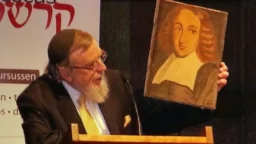
    In Baruch Spinoza, Contemporary Issues, Education and Jewish Thought and Philosophy

    Once the city magistrates of 17-century Amsterdam had made it abundantly clear to the Portuguese-Spanish Jewish Community that it could settle in Amsterdam only on condition that no member would ever dare to challenge the belief in the biblical God and the Old and New Testaments, Spinoza’s so-called heretical ideas became a serious challenge for the rabbis and leaders. It was a clear infringement of the agreement with the City of Amsterdam.

  • Spinoza – It Is Time to Lift The Ban

    In Baruch Spinoza, Contemporary Issues and Jewish Thought and Philosophy

    Spinoza, the celebrated seventeenth-century Amsterdam Jewish philosopher, is known as the father of the Enlightenment and has influenced generations of philosophers to this day. At the age of 23, he was excommunicated by the Portuguese-Spanish Jewish community of Amsterdam because of his heresies, which included his denying the existence of the Biblical God as well as the divinity of the Torah.

  • The Religious Scandal of Akeidat Yitzchak and the Tragic God Parashat Lech Lecha

    In Jewish Thought and Philosophy and Parashat HaShavua

    What is Avraham to do now? Should he rescue God from Himself and refuse to have a hand in this suicide attempt? Or should he perhaps become an atheist? After all, such a God cannot exist! But Avraham chooses neither of these options.

  • The Inescapable Obligation to Care For the Wicked

    By Yael Unterman

    If you were Abraham, would you have interceded for Sodom? Do you think that he was delighted at the existence of an entire city filled with evil as Sodom was? This man who the midrash describes as cursing the builders of the Tower of Babel for caring more for the loss of bricks than of human laborers? The answer is no, undoubtedly their behaviour nauseated him; yet still he tried to salvage it through the presence of ten righteous inhabitants.