Skip to content

Jewish Thought and Philosophy

  • Spinoza, the Alter Rebbe, and the Eternal Fire

    In Baruch Spinoza, Jewish Thought and Philosophy, Parashat HaShavua and Parashat Tzav

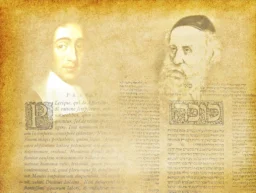
    The Talmud states that all the sacrifices were consumed by a heavenly fire, not by the fire lit by the Cohanim. This seems to imply that there was absolutely no need to keep the human fire on the altar burning so as to consume the sacrifices. So why were the Cohanim commanded to keep the fire on the altar lit? It seems that an answer may be found in contrasting the teachings of two very different thinkers--Spinoza, who famously did not believe in miracles, and the Alter Rebbe, who believed the existence itself is a miracle.


  • Prayer, Sexuality, and the Pleasure Principle

    In Jewish Thought and Philosophy

    Why are males and females physically attracted to each other? What is there in their physical appearance that makes them so excited that they want to be intimate, to the point where they consider this a great joy? The Sages of Israel understood the enormous power of sex and its immense challenges. Unlike other religions, such as classical Christianity, they never saw sexuality in a negative way. This is because sexual attraction is a reflection of Divine love.

  • Putting God on Trial: The problem of Divine Collateral Damage

    In Contemporary Issues, Jewish Thought and Philosophy and Theodicy

    The Jewish Tradition never told people not to question divine justice. Such questions are not only legitimate, they are holy because they rise from a deep realization that God is righteous and at the same time honest enough to admit that He is at fault.

  • Sunflowers by Vincent van Gogh

    The War and the Sunflower

    In Jewish Thought and Philosophy

    The holy task of Halakhic living requires us to see with more than our senses, and to comprehend what is beyond reason. It requires both inner consciousness and the transformation of the deed, by which we express our deepest understanding of the splendor of the world.

  • Sukkot

    The Paradox of Sukkot

    In Jewish Thought and Philosophy and The Jewish Year

    Nothing is more crucial for the religious personality than the question as to whether there is a God we can trust and rely on. Often, even one who believes that God exists may still wonder whether he can have faith in Him.

  • Binder folders

    The Future of a Marriage – The Good News File

    In Jewish Thought and Philosophy and Miscellaneous

    Experiencing low points in life is par for the course. Contending with these and the accompanying negative emotions and moods can be challenging and difficult. The correct perspective of what we have, our reality, and the true power we hold to alter and improve the direction of our lives is a sure tool in facing life.

  • Western Wall

    Tisha B’Av and Victimhood

    In Jewish Thought and Philosophy and The Jewish Year

    Tisha B’Av, the ninth day of the Hebrew month of Av, is often misunderstood—for Tisha B’Av is frequently perceived as a day of victimization, the date both Temples were destroyed and the Jewish People was transformed into a nation of eternal victims. If this was true, there would be no purpose to Tisha B’Av. If […]

  • couple studying together

    The Future of a Marriage – The Blessing of Marital Dialogue

    In Jewish Thought and Philosophy

    The Future of a Marriage – Part 2: The Blessing of Marital Dialogue * In memory of my dear friend Rabbi Dr. Sholom Gold z”l of Yerushalayim Words spoken at the festive meal (“Sheva Berachot”) on the occasion of the marriage of our grandson and his bride, Lakewood, USA, 24th of June.   As I wrote […]

  • newly weds hold hands

    The Future of a Marriage – The Art of Speaking

    In Jewish Thought and Philosophy

    Words spoken at the festive meal (“Sheva Berachot”) on the occasion of the marriage of our grandson and his bride, Lakewood, USA, 24th of June.   My dear grandchildren, Chatan (groom) and Kalla (bride), Yaacov Shlomo and Chava, Mazal tov! Oma and I were 20 and 21 years old when we married. This was only […]

  • Man thinking about meaning

    The Meaning of Life, Depression and The Red Heifer

    In Jewish Thought and Philosophy and Parashat HaShavua

    Parashat Chukat Depression is one of the worst conditions a human being may suffer. There are several reasons for the occurrence of depression. One that is very common results from feeling that life is meaningless. Combined with the fact that nobody can escape death, some people experience life as very painful. They do not suffer […]

  • Hebrew Bible pages words

    The Holiness of Words

    In Jewish Thought and Philosophy and Miscellaneous

    Man alone was endowed with the gift of words and the ability to connect thereby with his Creator. Language can comprise grandeur, while it can also be emptied of its value and essence. How we choose to live our lives affects how we express ourselves and the language we use. The debasing of language today stems from and represents unfortunate moral and ethical decay.