Yom Yerushalayim: The City and People of Eternity
A poem for Yom Yerushalayim.

A poem for Yom Yerushalayim.
In Jewish Thought and Philosophy, The Jewish Year and Yom Kippur
The day after Yom Kippur, the synagogue service really should be a completely different experience from what people are used to. Yom Kippur should still be in the bones of all synagogue participants. Its spirit should still be felt with every prayer. It should be completely impossible for synagogue services to return to their old ways, in which prayers are said as if “nothing happened.”
A parable for Rosh Hashana, plus, two new podcasts: On music as religious experience, and on the importance of bringing children into the world.
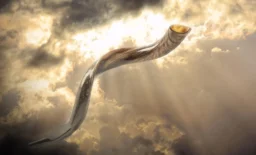
The blowing of the shofar proves that we can surpass ourselves. On our own, using our vocal cords, we are unable to produce this sound – a terrifying penetrating resonance. Alone, we cannot produce a sound that comes close to the piercing and penetrating heavenly voice of the shofar, which can cause human beings to break down, pick themselves up again, and transform into new individuals.
In the wake of the destruction of Jerusalem the leaders of the Jewish people despaired. But the ordinary Jews did not. Despite the total collapse of Jewish life, they opted for the impossible. They not to listen to their leaders, but continued building the nation of Israel, as they had previously been taught by the very sages who now despaired. Sometimes, the simple man has more faith in the Jewish future than the greatest Talmudic scholar.
A flame grows or diminishes depending on the combustibility of the material it comes in contact with. So it is with human openness to the divine. Their receptivity to the divinity of Torah is proportionate to the condition of their soul.
Yom Ha’atzmaut commemorates the anniversary of a marriage that has lasted more than 3,500 years. This may sound like a paradox, but it is the inescapable truth about the Land of Israel and the Jews. No marriage has lasted so long, been so deep in its commitment and so overwhelming in its love as the one between the Jews and their homeland.

In Jewish Thought and Philosophy, The Jewish Year and Passover
It is a great joy to study Faith and Freedom: Passover Haggadah, With Commentary from the Writings of Rabbi Eliezer Berkovits. In this Haggadah, not only do we find very interesting insights by Rabbi Berkovits on themes that relate to Pesach, but we also get somewhat of an introduction to his philosophy and unique halachic approach in general.

In The Jewish Year and Purim
Some appropriately irreverent thoughts to...well, no, not to ponder on the occasion of Purim.
On Simchat Torah we begin reading the Torah all over again. Even the greatest Torah scholars once again come to the conclusion that they need to reread it, since they failed bitterly the previous year. After all, we only start reading the first words and already we get stuck, unable to understand the actual meaning; and we can never really get beyond that place. While in the non-Jewish world the whole point is to finish a book, in Judaism we are all just perpetual beginners.
Running our world by remote control has not been good for our souls; and walking on the moon has not helped us to know our next-door neighbor any better. On the contrary, technological progress has robbed us of our own humanness. It is therefore most meaningful that one item has maintained its constancy. It carries a text that has had greater influence in the world than any other we know of. It has changed the universe as nothing else has; it encourages people to move, to discover, and to develop. But it is written on parchment, by the hand of a person, holding a quill, as if to say: Be yourself. Don’t get run over by the need for progress.
In The Jewish Year and Rosh Hashanah
Every ordinary act should be turned into a kind of mitzvah, a spiritual challenge, making it a dignified encounter with God. On Rosh HaShanah and Yom Kippur we are reminded that our deeds must redeem God’s presence and rescue Him from oblivion. In doing the finite we must be able to perceive the infinite.