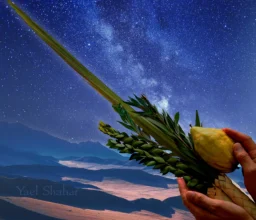
After the intensity of judgment and self-scrutiny of Rosh HaShanah and Yom Kippur, Sukkot offers a surprising response: joy born of vulnerability. Leaving the security of our homes, we dwell in fragile huts exposed to wind, rain, and uncertainty. Sukkot teaches that faith is not found in control, but in trust; not in permanence, but in openness to life’s instability. True joy can arise, not despite fragility, but because of it—when we accept that meaning emerges precisely where certainty ends.
While other holidays are said to be times of joy as well, Sukkot is singled out in particular by the Torah (D'varim 16:15): "You shall be altogether/only joyful." But can we ever be "only" joyful? Is there ever a time when we are completely without other emotional states? Is the Torah asking of us the impossible?
Winter - bleak, dreary and cold - often has a negative effect on our moods and even outlooks. The message of Sukkot, The Festival of Tabernacles, must be continued into this period of darkness and, indeed, into our lives.
The Sukkah is a structure that is quite plain and feeble by definition and requirement, and yet it interior and significance are tremendously beautiful and solid. Our lives can be greatly enriched and understood and even assigned deep purpose when we understand the Sukkah.
As is well known, the Succah visualizes our life span in the world. For what is a Succah? It is a frail structure which we need to dwell in for seven days. Many commentators remind us that these seven days represent man's average life span which is about seventy years.
No matter how powerfully the outside walls and the leaking roof reveal our vulnerability and uncertainty, inside these walls we need to make our life as attractive as possible and enjoy its great benefits and blessings.
Sukkot and the Paradox of Life – Judaism’s Realistic Joy
When contemplating the festival of Sukkot, we are confronted with a remarkable paradox. As is well known, the sukka symbolizes our life-span in the world. For what is a Sukka? It is a frail structure in which we need to dwell for seven days. Many commentators remind us that these seven days represent Man's average life-span, which is about seventy years. This was well stated by King David when he wrote: "The span of his years are seventy and with strength eighty years" (Tehillim 90:10). Indeed under favorable circumstances, we may prolong our stay in this world into our eighth day which is symbolized by Shemini Chag Atzeret (a separate festival immediately following the seven days of Sukkot).
When contemplating the festival of Succoth, we are confronted with a remarkable paradox. As is well known, the Succah visualizes our life span in the world. For what is a Succah? It is a frail structure in which we need to dwell for seven days. Many commentators remind us that these seven days represent man's average life span which is about seventy years. This is well stated by King David when he wrote: "The span of his years is seventy and with strength eighty years." (Tehilim 90:10) Indeed under favorable circumstances, we may prolong our stay in this world into our eighth day which is symbolized by Shemini Chag Atzereth, (a separate festival immediately following the seven days of Succoth).