
Session 1: Rav Ovadia Yosef z”l, Similes, and Competing Values
Compiled by Think Tank Member Diane Meskin
The first session of the year 5774 at the David Cardozo Academy Think Tank took place just a few weeks ago, and it had the usual mix of intriguing activities, discussions, and food for thought regarding how we relate to halacha and where and how the individual comes into the picture.
As it was the first meeting since the passing of Rav Ovadia Yosef, Rabbi Cardozo opened by speaking about the unique Jewish world and culture in which Rav Ovadia lived and gave halachic rulings. Rabbi Cardozo noted that Rav Ovadia’s unparalleled encyclopedic knowledge of the halacha in some ways may have been what allowed him to make certain radical rulings that those without his knowledge would likely not have been able to make for fear of how others would judge or challenge the ruling. He made a number of famously lenient rulings, for example on mamzerut (regarding the legal status of children from forbidden relationships) and the agunah problem. A former member of the Think Tank added that perhaps this was the case in his famous halachic ruling in which he allowed the Israeli government to enter the Oslo Peace Process – perhaps only someone so respected and unrivaled in his halachic knowledge could have gotten away with such a problematic ruling.
Rabbi Cardozo compared and contrasted this loss to another great Rabbi we lost this year – Rabbi Dr. David Hartman. Where they both had great guts, or chutzpa, to make statements about the tradition and law, for Rav Ovadia it was in the realm of halacha, and for Rabbi Hartman it was in the realm of philosophy. Rabbi Hartman was coming from a completely different world – an Ashkenazic world where committed (religious and secular) Jews are challenging the tradition, not because they found halachic life difficult but because they had deep moral and intellectual problems with the law. This of course is nearly the opposite of the culture in which Rav Ovadia operated, a world in which people believe in Torah MinHaShamayim – the complete divinity of the Torah, but need encouragement to keep the law more strictly or at all. Rabbi Cardozo suggested that it may even be the case that Rav Ovadia never thought about the grand ideas of Judaism, or the music of Jewish life. He noted that in many ways, Rav Ovadia was an anti-intellectual, at least in the Western sense of the word. His often outrageous statements about the Holocaust, Israeli politicians etc. in his popular public lectures must be seen in this light; but one continues to wonder why he did so when he was surely aware that the media were listening and would make them public causing great damage to the reputation of Judaism.
It might be that since the population he answered to was less concerned with these intellectual issues, it afforded him a type of luxury to focus exclusively on halacha. In either case, both Rabbis made unbelievably important contributions and were not afraid to speak their mind or be challenged by others, and both constitute a great loss.
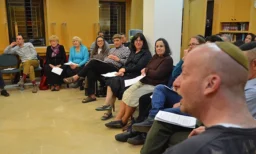
The next part of the meeting was an icebreaker intended to reacquaint the group after the summer break and meet two new members. Although meant mainly as an icebreaker, the activity was perhaps one of the highlights of the evening as it brought out some very inspiring and thought-provoking ideas. Members had been asked to prepare a simile for their relationship to halacha, and were asked to fill in the blank: “my relationship to halacha is like_____”. The answers were varied and fascinating, and all reflected different aspects of peoples’ relationship with halacha, ranging from the more challenging aspects to the more inspiring. Some related to the evolving relationship with the halacha as a system – like Legos which at first one builds according to the instructions, but eventually feels free to turn to more creative constructions; or like a computer, where the more we understand how it operates, the more easily we can fix a malfunction or bug, rather than walking away and blaming the machine; or like driving stick shift, where the better one understands how the gears work and gets the hang of it, the more confidence and control one feels on the road. Others likened their relationships to the halacha to interpersonal relationships reflecting both deep commitment but also frustration, lack of control, or distrust in some cases – like a troubled marriage, or a subject’s relationship to his master, or a manager in a large company. Other similes reflected the texture and complexity of halacha as well as its constancy, comfort, and duality. For a full list of the similes, see here.
The topic for the evening was the final session on the topic of Competing Values which was started during last year’s Think Tank. The session started with a technique that the DCA has adopted from the Ayeka organization, called “Spiritual Chevruta,” in which two members sit together and take turns responding to various questions and prompts, listening to the other and only ask clarifying or follow-up questions rather than having a discussion or challenge the other. The goal is to truly listen to their thoughts and feelings about the topic. This spiritual chevruta revolved around the idea of “halachic values”: where they intersect with our personal values, and how we go about challenges that come up in the tension between what one feels are halachic values and other values that one upholds. In the sharing session that followed, members were asked to bring examples of competing values in their personal experience. The examples that were shared reflected a number of challenges within the halachic system. One example was the struggle to navigate a romantic adult relationship as a person in their thirties or forties, and maintain mental health and authenticity, in a system that promotes rules of restraint that run the risk of stifling the relationship, and were crafted at a time when people married young and quickly. Another example was between shmirat negiyah (laws regarding physical touch between men and women restricting it to spouse and immediate family) and the other Jewish value of kvod habriot (human dignity and making an effort not to embarrass or humiliate someone of the opposite sex who extends their hand to you), this being a tension sensed between the letter of the law and the spirit of the law.
Rabbi Cardozo added that there are a number of halachot that seem to be based on an assumed distrust of the individual’s judgment in a given situation, and that this can often present challenges. One example of this are the laws concerning Yichud, men and women being alone, which are extremely strict.
The final section of the evening involved reading and discussing a section of Rabbi Emanuel Rackman’s, (former Chancellor of Bar Ilan University) 1961 essay “The Dialectic of Halakhah” in which he brings out the inherent duality in Judaism – immanence and transcendence, particularism and universalism, law and freedom, other-worldliness and this-worldliness, vision and pragmatism, see here This was a trigger to continue the discussion on competing values and navigating them from the perspective of a committed Jew. Rabbi Cardozo mentioned a phenomenon that he found troubling, as did others – oftentimes those who write such thoughtful analyses about Jewish law and life as this one, are rather relaxed about their own halachic observance. He asked if members also felt this and if they thought it was coincidental or if there is a mechanism connecting those with more liberal views on the big picture of halacha and being less strict about the letter of the law.
Members agreed that this phenomenon exists, including in the more “progressive” circles where various minyanim and movements are attempting to combine halachic observance with more liberal ideas such as feminism, egalitarianism, etc. Most people felt that there does seem to be a connection between open-mindedness on halacha as a system and laxity where the letter of the law is concerned, although they did not feel that this necessarily has to be the case. Members suggested different possibilities for the reason for this phenomenon or mechanisms for it. One possibility is the tension between submission to the halacha and my autonomy and role in helping the halacha evolve; struggling to find the right balance between these two. Leaning toward the importance of evolving the halacha can easily lead to a more general casualness about the law.
Another suggestion was that perhaps people switch their focus from the details of the law to what they understand to be the principle of the laws which can lead one to focus, for example, on the idea of Shabbat as a day of rest rather than how exactly to prepare tea on Shabbat. Another member added that this is what is particular to the Haredi approach which literally means trembling, and there is a real trembling about keeping the law strictly. That is to say, that if you treat chametz as if it is “anthrax”, then you will certainly be sure to get rid of every last bit of it before Passover. But if you treat it historically or symbolically – e.g. as a symbol of leaven or haughtiness or arrogance – then you will get rid of it but be less strict on the technical precision about the law. It depends a lot on whether one treats halacha as the Word of God or as one path of connection to God among others. It will fundamentally influence the hierarchy of values for someone trying to live a committed Jewish life.
Questions for our readers to discuss:
- What is your view of Rav Ovadia Yosef? Was his lack of “engagement with the grand ideas of Judaism” a flaw in your eyes, or on the contrary his recipe for success/simply who he was?
- What’s your simile? What is your relationship to halacha like?
- Have you ever experienced a case of competing values? If so, how did you manage the situation?
- Do you feel that “there does seem to be a connection between open-mindedness on halacha as a system and laxity where the letter of the law is concerned”?