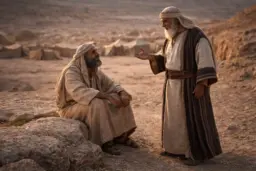
According to our Sages, Moshe Rabbenu’s father-in-law, Yitro, was not only the High Priest, the pope, of Midian—a supreme religious authority in an age when idol worship dominated the world—but also a man who ultimately converted to Judaism after hearing about the Exodus from Egypt and the splitting of the Sea of Reeds. (See Rashi on Shemot 18:1)
This was a momentous decision in more ways than one. Just imagine if Pope Leo XIV were to abdicate today, declare that he no longer believes in Catholicism, and announce that Yeshu is a false messiah. The religious shockwaves would be seismic. Billions would be shaken. Some would abandon their faith; others would be devastated. The Pope would likely be forced into hiding, fearing the fury of zealots. The world would never be the same.
Yitro’s decision was no less radical. To abandon his ancestral religion and relinquish his position of supreme authority required extraordinary inner strength. He must have known that he was giving up everything: honor, wealth, social standing, and security. He became an outcast, ridiculed and ostracized by his own people. His former world turned against him. One can hardly imagine the loneliness and fear of such a life, lived solely for the sake of truth.
What then compelled Yitro to make such a dangerous and seemingly irrational choice? What kind of inner certainty motivates a person to set nearly the entire world against himself? What was his secret?
Whatever the answer may be, one thing is clear: Yitro must have encountered something in Judaism so vast, so elevated, so compelling, that he could not ignore it—even at unbearable personal cost.
Surely he was torn by doubt and inner conflict. One can easily imagine the turmoil in his home. Did his wife and children stand by him, or did they oppose his decision? This must have been agony not only for them, but for Yitro himself.
I am reminded of the Kotzker Rebbe (1787-1859), a man of uncompromising honesty, who lived in constant struggle with himself and endured an extraordinarily difficult life. Truth, when taken seriously, is never comfortable.
True freedom means not giving in to any outside pressure, not becoming habitual and not seeking to please oneself or anyone else.
But it is more. When Yitro advised Moshe to change the judiciary (Shemot 18:19-22), was he not warning him and the Israelites not to allow the Torah to become routine, regulated and codified? Could it not become a stagnated system in which fervor and passion would be lacking? Should the Torah and its commandments not be a breakthrough and a rebellion against religious conformity and secularity, which a court structure could easily become?
Wasn’t Yitro starting a “Kotzker-like” movement to protest religious trivialization? Wasn’t he warning the Israelites not to accept the Torah routinely but to search for it?
For many of us, Yitro presents a profound challenge. He stands as a challenge for those who have drifted away from Judaism, or who never truly took it seriously to begin with. And even for the religious, including myself, he shakes our complacency.
Most Jews take their Jewishness for granted. In the Land of Israel, it surrounds us at every corner. It hovers over us with such intensity that paradoxically we stop noticing it altogether. It becomes background noise.
But Yitro, the outsider, confronts us with an uncomfortable question: Would you choose Judaism if you had not been born into it?
Many of us, if we are honest, would answer: no.
Yitro would then ask: Why not?
Have we studied Judaism deeply enough to make an informed decision? For many, Jewish education ended at the Bar or Bat Mitzvah. Perhaps Sunday morning soccer was deemed more important. But soccer—however meaningful—does not provide identity, nor does it offer ultimate meaning in life.
Judaism does.
Judaism is not just a religion. It is much more. Walter Kaufmann (1921–1980), the secular Jewish philosopher and renowned Nietzsche scholar, once wrote: “What the Jews have traditionally sought in the Torah was not merely a way of life nor truths but—this is scarcely an exaggeration—everything…”[1]
But this “everything” comes with a personal cost: responsibility. Rabbi Abraham Joshua Heschel writes:
The dignity of man stands in proportion to his obligations as well as to his rights. The dignity of being a Jew is in the sense of commitment, and the meaning of Jewish history revolves around the faithfulness of Israel to the covenant. (God in Search of Man, p. 216)
Judaism cannot be understood from the outside. It must be lived. One must “hear in the doing,” as Franz Rosenzweig taught. (Franz Rosensweig, On Jewish Learning) Rosenzweig himself once rejected Judaism, only to return to it after profound inner struggle, realizing how deeply mistaken he had been. Those who have never “lived” Shabbat are like the man who is deaf and declares that music is nonsense.
Perhaps Yitro returned to Midian (Shemot 18:27) because the Israelites did not want to hear his message of absolute honesty and banished him from their camp. This is but one example of the Talmudic statement that some proselytes are like an irritating skin ailment (Yevamot 47b)
Only those who have studied Judaism seriously, and above all, lived it fully, and then rejected it for compelling reasons may truly challenge Yitro.
But who among us can honestly say that we have done so?
Questions for the Shabbat Table
- The Midrash teaches that Yitro had worshipped every form of idolatry before converting (cf. Mechilta, Yitro). Does this make him uniquely qualified to recognize truth—or does it suggest that doubt and experimentation, even religious “failure,” are necessary steps toward genuine faith?
- Rabbi Heschel emphasizes obligation as the core of Jewish dignity. But modern culture emphasizes autonomy and self-expression. Is it possible to translate covenantal obligation into a language that modern Jews can genuinely embrace—or must Judaism remain countercultural to survive?
- The essay asks: “Would you convert to Judaism if you were not born Jewish?” Is this a fair question—or does it assume that truth must always be consciously chosen? Can you think of truths that can only be received through inheritance and belonging rather than decision?
- Franz Rosenzweig returned to Judaism after rejecting it—but only after intense struggle. Should Jewish education intentionally create space for doubt and even rejection, or does this risk losing people entirely? Where is the line between productive struggle and spiritual danger?
Notes:
[1] Walter Kaufmann, Critique of Religion and Philosophy (Princeton, NJ: Princeton University Press, 1979) pp. 268-276.

Rabbi Nathan Lopes Cardozo
Rabbi Dr. Nathan Lopes Cardozo is the Founder and Dean of the David Cardozo Academy and the Bet Midrash of Avraham Avinu in Jerusalem. A sought-after lecturer on the international stage for both Jewish and non-Jewish audiences, Rabbi Cardozo is the author of 13 books and numerous articles in both English and Hebrew. He heads a Think Tank focused on finding new Halachic and philosophical approaches to dealing with the crisis of religion and identity amongst Jews and the Jewish State of Israel. Hailing from the Netherlands, Rabbi Cardozo is known for his original and often fearlessly controversial insights into Judaism. His ideas are widely debated on an international level on social media, blogs, books and other forums.