Thoughts to Ponder 810
A Summary to Nathan Lopes Cardozo’s new Hebrew book: Halacha Ka-Mered
In Halacha
Based on Rabbi Dr. Ido Pachter’s Introduction
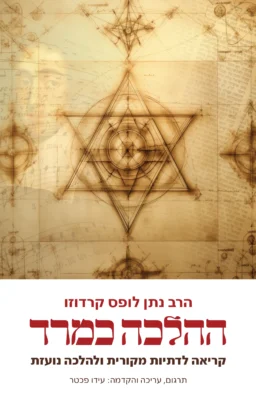
Several months ago, the prestigious Israeli publisher Yediot Acharonot published the Hebrew version of my book, Jewish Law as Rebellion: A Plea for Religious Authenticity and Halachic Courage which was first published by Urim Publications, (Jerusalem, New York) in 2018.
The Hebrew edition is titled: ההלכה כמרד: קריאה לדתיות מקורית והלכה נועזת
The book was translated by my dear friend Rabbi Dr. Ido Pachter. But this is more than just a translation. Rabbi Pachter re-structured the book to make it more readable to an Israeli readership and provided it with a long introduction to my philosophy of Halacha and to some of my novel Halachic suggestions. As was to be expected (and as I had hoped), the book sparked a lot of critique but also a lot of praise. Major Jewish thinkers wrote important recommendations to the English edition, among them as former Chief Rabbi Lord Jonathan Sacks z.l., and the Halachic expert Rabbi Professor Daniel Sperber of Bar Ilan University. The book was also praised by former Anglican Archbishop Rowan Williams and the leader of the pro-Israel Islamic Community, Imam Yahya Pallavicini in Italy.
Rabbi Pachter’s new introduction is very helpful in facilitating a better understanding of the book and of my philosophy. I have translated it into English from the original Hebrew and plan to post it here in the coming weeks. To increase the clarity of some of the ideas, I am adding here a kind of “introduction” to Rabbi Pachter’s introduction for those who are not familiar with my perspective on Judaism and Halacha.
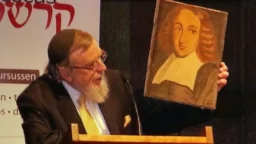
As explained by Rabbi Pachter, the book is in many ways a protest against the famous Dutch philosopher of Jewish descent, Baruch Spinoza (1632-1677) who believed that Judaism—like all other religions—is an expression of passive obedience, submission, and an attempt to constrain people and deny them moral freedom.[1]
While there is much to admire in the philosophy of Spinoza, it is my opinion that he misread (sometimes deliberately) the Jewish Tradition.
There are three pillars on which, I believe, Judaism and Halacha are built. All of them are a refutation of Spinoza’s critique.
They are:
- The function of Halacha is to disturb religious complacency; to fight spiritual contentment and make Judaism into a moral and religious protest movement.
- To teach the art of radical amazement so we may live in utter astonishment, to undo the erroneous belief that life is ordinary and to be taken for granted. The purpose of the mitzvot is to live in “wonder” and to translate them into deeds, providing a pathway to meaning.
- To protest against religious dogmatism and literal-mindedness, and to realize that the purpose of the word of God is to overthrow the “certainty” of the Biblical text.
I will elaborate on these three principles below.
- The original architect of Judaism was Avraham, the archetypal protestor. He discovered God and protested against the world of idol-worship and immorality. In doing so, he laid the foundation for a universal mission: Ethical applied monotheism. Through personal upheavals, challenges and struggles, his children expanded and deepened this notion until the family grew into a tribe, and ultimately developed into a highly unusual nation that sees its task as the betterment of the world.
To enable all of this, God provided this people with many directives (mitzvot). These directives were meant to make the Jewish people into a “light to the nations”, a driving force” that would inspire humankind to live a life of dignity and nobility. This found its pinnacle in the giving of the Torah in the days of Moshe. Accordingly, all of Jewish Law must be redemptive, with the goal of causing the Jewish people to transcend itself to even higher standards of religiosity and morality. It must stay rebellious and be a protest movement. No faith can stay relevant without constant repair.
- Judaism is meant to induce in us a state which Rabbi Avraham Yehoshua Heschel termed “radical amazement”. We should never get used to “normality “. Every moment must be a challenge, and a protest against conventional notions and mental clichés. Whether it is the food we eat, the flowers in our garden, the animals around us, our scientific research…all of it must invoke wonder. To make Judaism comfortable and compatible with an easy lifestyle is deadly. It puts us to sleep. Instead, it needs to tell us what we need to hear, not what we want to hear. Religious life should never be a form of spiritual plagiarism, a recap of the day before. It should entirely be novel. To live in the presence of God means that every moment is a Divine surprise, and of outmost importance. It is to live in the presence of the King, and that means that it is a challenge.
Judaism is not just a philosophy or a belief system that admonishes us to live in wonder. It is wonder translated into action. This is the ultimate purpose of the mitzvot; to ensure that “everydayness”, including “trivialities” become holy. Even routine should become holy excitement.
- The Genius of Judaism can never be translated into dogma. Faith can only be found in the light of one’s soul, never in doctrine. Dogmas reach only the mind, not the human heart. Trying to translate faith into dogma is a misguided technical exercise that leaves the human heart empty of that which is crucial to religious experience. Faith is the art of living with a question and recognizing the spiritual power of the query, which only dies when it is answered. Faith is the refutation of an attempt to reconcile theological declarations; instead, it holds them, suspended, and through this tension it creates vitality.
Dogmas are essentially descriptive and normative. They can’t penetrate the mystery hovering over all questions and answers. They are unable to formulate the relevance of that which surpasses final beliefs. Faith thrusts the religious person into a place of reality that the mind cannot grasp, and that words do not reach. It is a moment when all definitions come to an end, when any attempt to come to conclusive principles can only be a subtraction that is unnecessary in the heart of the person of real faith.
Genuine Judaism can be understood only in its natural habitat of deep faith and piety, in which the Divine reaches all thoughts. In faith, one must enter the world with all that he or she is and has. One does not sacrifice one’s life for dogma, but only for deep religious faith. The Biblical text is indicative: it calls for fluidity and to that which is beyond words. It resists definitions and even suggests that “the Halacha can uproot the Torah—Yesh Koach B’Y’dei Chachamim L’Akor Davar Min HaTorah B’Shev V’Al Ta’aseh).[2]
Jewish Law as Rebellion was written with three objectives in mind. It is an honest attempt to introduce the reader to the grandeur of Judaism. The book is not meant to give final halachic rulings on crucial issues, but rather, to suggest ways to solve halachic problems, and to portray Judaism as a vibrant movement whose wisdom is much needed in today’s world.
It is with these principles in mind that Rabbi Pachter starts his introduction, my translation of which which will be posted over the next few weeks.
Notes:
[1] See: Tractatus Theologico Politicus, chapter 15.
[2] Yevamot, 89b-90a.

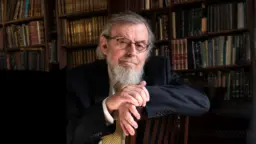
Rabbi Nathan Lopes Cardozo
Rabbi Dr. Nathan Lopes Cardozo is the Founder and Dean of the David Cardozo Academy and the Bet Midrash of Avraham Avinu in Jerusalem. A sought-after lecturer on the international stage for both Jewish and non-Jewish audiences, Rabbi Cardozo is the author of 13 books and numerous articles in both English and Hebrew. He heads a Think Tank focused on finding new Halachic and philosophical approaches to dealing with the crisis of religion and identity amongst Jews and the Jewish State of Israel. Hailing from the Netherlands, Rabbi Cardozo is known for his original and often fearlessly controversial insights into Judaism. His ideas are widely debated on an international level on social media, blogs, books and other forums.