Thoughts to Ponder 94
The inner fire, or “Familiarity breeds contempt”
A Chassidic Rebbe was once asked: “If you could save one thing from your burning home, what would it be?”
“The fire,” answered the Rebbe, “because it is the brenn[1] which makes life worth living.”
Indeed, life becomes meaningful and thus worth living, only when our soul “burns from within” for our ideals and our life’s purpose. It is an artform to live each moment as new, as unique, as a challenge, and as an encounter with the Divine.
In the book of Yechezkel, we find a most revealing instruction concerning the common people who visit the Temple on the festivals:
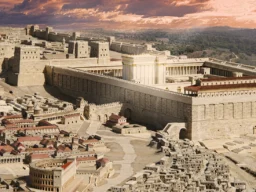
On the mo’adim (festivals) when the common people come before the Lord, whoever enters the north gate to bow low shall leave by the south gate, and whoever enters by the south gate shall leave by the north gate.
They shall not go back through the gate by which they came, but they shall go out through the opposite one.[2]
What difference could it possibly make whether one leaves through the north or south gate?
Rabbi Jonathan Eybeschuetz, 18th century author of the classic Yaarot Devash provides a most profound explanation for this seemingly bizarre command: “God was particular that they should not see the same gate twice. Lest they see the Temple gate like they see the gates of their homes.”
The prohibition of leaving the Temple via the same route one entered, was instituted in order that no one would get accustomed and desensitized to the Temple’s environment by seeing it twice from the same point of view. Nothing is more dangerous than getting used to one’s surroundings. As the saying goes: “Familiarity breeds contempt.” This indeed is the essence of proper religious life—to avoid complacency and to make sure that one remains astonished and amazed by life.
To appreciate life requires a special kind of mindset. One must cultivate the ability to see things differently, to reframe, to change perspectives, sometimes to turn a thing upside down. This is one of the great blessings of religion. Most of the time religious insight does not reveal something entirely new but rather calls attentions to those things one has seen before but never properly noticed.
Western culture offers a very limited and selective view of life. In fact it completely ignores much of what is most beautiful, rendering them invisible, and thereby making it extremely difficult to enjoy life fully and to feel the exhilaration of existence. Religion is a protest against this narrow-mindedness that takes so much for granted, allowing for deep meditation on the wondrousness inherent in the most simple events. Religion transforms the obvious and mundane into the mysterious and mystical. Ludwig Wittgenstein, the great Austrian philosopher remarked that, “Not how the world is, but that it is, is the mystical.” Not how we are, but that we are is cause for unceasing wonder.
To see the world in a grain of sand
And heaven in a wild flower
Hold infinity in the palm of your hand,
And eternity in an hour
(William Blake, “Auguries of Innocence”)
The raison d’être of the Temple was to give people an opportunity to see and understand the world from an entirely different perspective. The symbolism of its construction and the vessels found within forced men to wake up from their secular ideologies and see the world’s divine metaphysical dimensions. To underscore this fact, and to ensure the success of the Temple’s purpose, the common people were not allowed to see one gate twice during a single visit, lest they fail to internalize the Temple’s message…lest they continue to live their lives without an inner brenn.
Notes
[1] Brenn is a German-Yiddish expression for an emotional inner-fire in the heart of man
[2] Yechezkel 46:9.

Rabbi Nathan Lopes Cardozo
Rabbi Dr. Nathan Lopes Cardozo is the Founder and Dean of the David Cardozo Academy and the Bet Midrash of Avraham Avinu in Jerusalem. A sought-after lecturer on the international stage for both Jewish and non-Jewish audiences, Rabbi Cardozo is the author of 13 books and numerous articles in both English and Hebrew. He heads a Think Tank focused on finding new Halachic and philosophical approaches to dealing with the crisis of religion and identity amongst Jews and the Jewish State of Israel. Hailing from the Netherlands, Rabbi Cardozo is known for his original and often fearlessly controversial insights into Judaism. His ideas are widely debated on an international level on social media, blogs, books and other forums.