Thoughts to Ponder
From Anger to Awe
Moshe’s Pugnacity and the Greatness of Self-Transformation
Parashat Devarim begins with what may be the most impressive speech in human history: Moshe Rabbeinu’s farewell discourse. For nearly a month, at the age of 120, Moshe addresses the people with moral clarity, spiritual urgency, and astonishing eloquence.
Yet forty years earlier, this same man had protested to God: “I am not eloquent… I am slow of speech and slow of tongue” (Shemot 4:10). How did this reluctant, speech-impaired shepherd become the greatest orator and leader the world has ever known?
The Torah offers one startling answer: “The man Moshe was exceedingly humble, more than any person on the face of the earth” (Bamidbar 12:3). Nothing is said about his intelligence, righteousness, or leadership—only his humility.
This is nothing short of astonishing.
The Paradox of Greatness
Moshe, who led the Israelites out of Egypt, split the Red Sea, received the Torah, and spoke to God face-to-face…. How could someone so accomplished remain so modest? Surely, even for a moment, he must have felt a sense of pride in his achievements.
But this is exactly the point! True greatness lies in something beyond mere achievement. As the prophet Yirmiyahu declared:
Let not the wise man boast of his wisdom, nor the strong man boast of his strength… but let him who boasts boast in this: that he understands and knows Me (Yirmiyahu 9:22–23).
The Talmud teaches that “All the prophets saw through a glass darkly, but Moshe saw through a clear lens” (Yevamot 49b). Rashi adds a profound twist: the other prophets thought they saw God, but Moshe, seeing clearly, understood that he saw nothing at all. The more one truly sees God, the more one realizes how incomprehensible He is. The deeper the encounter with the Divine, the greater the humility it inspires.
This ultimate experience humbles rather than exalts.
Moshe’s Unlikely Résumé
Moshe’s personal history makes his transformation even more remarkable. In fact, his resume at the time he assumed leadership did not inspire confidence:
- 80 years-old, not exactly the time of life to start a new career!
- Married to a Midianite woman, daughter of the idol-worshipping Yitro
- Raised in Pharaoh’s palace. No Jewish education. No community service
- A history of brawling and physical violence
- Previous experience: herding sheep
- No publications of note!
Nothing in Moshe’s background hinted at his future greatness.
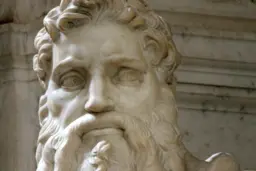
The Tiferet Yisrael (Rabbi Yisrael Lipschitz, 1782–1860) recounts a curious tale:[1] A foreign king, having heard of Moshe’s greatness, sent artists to paint his portrait. Each returned with an image of an angry, harsh-faced man. Enraged, the king traveled to meet Moshe himself—only to discover the artists’ renditions had been accurate.
When asked how such a visage could belong to a righteous man, Moshe replied: “Indeed, I was born with bad character traits. But through decades of inner struggle, I refined myself. My face still bears the imprint of my nature, but my soul has been transformed.”
God, he explained, wanted a leader who was not born righteous, but one who became righteous through his own effort. That journey is the true source of inspiration.
Chosen Not for Perfection, But for Potential
This same idea lies at the heart of Jewish uniqueness. The Talmud provocatively asks:
Why was the Torah given to the Jewish people? Because they are impetuous and hotheaded. (Beitzah 25b)
These are not exactly flattering characteristics! And yet, the Talmud suggests that the Torah was given precisely because of the Jewish people’s difficult nature. As the Divrei Chaim (Rabbi Chaim Halberstam of Sanz, 1793–1876) explains:
“By nature Jews are obstinate, so the Torah was given to them to break their obstinacy with prohibitions, and restrictions against arrogance, adultery, and robbery… [2]
To our great surprise the Rebbe adds the following words:
But the other nations do not need these extra restrictions, because they are not pugnacious by nature, so that for them the seven Noachide laws are sufficient.”
This is a daring statement, coming from a man who was known for his great love and admiration for the Jewish people. It shows courage and independence of mind, but above all an adherence to truth.
It cannot be denied that there are many people who by nature are well behaved. But at the same time, they cannot be an example for righteousness since it comes naturally to them.
It is not the naturally virtuous who are chosen for great things, but those who must work and struggle. Only those who know darkness can bring true light.
Excellence Born of Effort
Spinoza once remarked: “All things excellent are as difficult as they are rare.”[3]
Moshe’s greatness was not innate—it was forged through personal effort. He was not born with a perfect character. He became great through daily, relentless refinement. His humility was not an accident; it was the culmination of a life-long spiritual labor.
This insight is liberating. It means that all of us too, can aspire to greatness—not by being born perfect, but by struggling towards perfection.
To be “a light unto the nations” (Yeshayahu 42:6) is not about moral superiority. It is about moral courage—the willingness to confront one’s flaws, to fall and rise again, and to live by a vision larger than oneself.
The Jewish people, like Moshe, are called by God, not because they are better, but because they are capable of becoming better—through Torah, through struggle, through humility. The Torah is not a badge of pride, but a blueprint for growth.
To live this truth is to accept the immense challenge and privilege of spiritual self-transformation.
From Harshness to Holiness
Moshe’s farewell speech is not merely a review of laws or history. It is the culmination of a life forged in humility and hardship. It is a testimony to what a human being can become when they do not rely on talent alone, but commit to becoming more than they are.
Like Moshe, we may begin our lives with limitations. We may be angry, fearful, or unsure. But we are not bound by those traits. We can refine ourselves.
To admit this is not arrogance—it is faith. To deny it is to commit spiritual suicide.
The message of Parashat Devarim is not only about a leader who found his voice, but about a people who must find theirs—in the struggle toward greatness, in the humility that precedes wisdom, and in the courage to grow and change.
Notes:
[1] Tiferet Yisrael, commentary to Mishnah Kiddushin 4:14, note 77. Paradoxically this may throw some light on Moshe’s killing of the Egyptian (See Shemot 2:11-15).
[2] Divrei Chaim, Responsa Part 1, Yoreh Deah 30, brought in Prof. Leo Levi’s article, “Israel and the Nations,” Encounter: Essays on Torah and Modern Life, ed. H. Chaim Schimmel and Aryeh Carmel, Association of Orthodox Jewish Scientists, Feldheim Publishers, Jerusalem-New York, 1989, pp. 140-168.
[3] Benedict De Spinoza, Ethics. Translated from the Latin by R.H.M. Elwes (1883), Dover Publications, Inc. New York. P. 271.

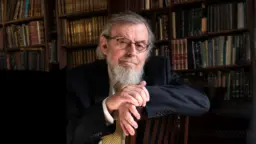
Rabbi Nathan Lopes Cardozo
Rabbi Dr. Nathan Lopes Cardozo is the Founder and Dean of the David Cardozo Academy and the Bet Midrash of Avraham Avinu in Jerusalem. A sought-after lecturer on the international stage for both Jewish and non-Jewish audiences, Rabbi Cardozo is the author of 13 books and numerous articles in both English and Hebrew. He heads a Think Tank focused on finding new Halachic and philosophical approaches to dealing with the crisis of religion and identity amongst Jews and the Jewish State of Israel. Hailing from the Netherlands, Rabbi Cardozo is known for his original and often fearlessly controversial insights into Judaism. His ideas are widely debated on an international level on social media, blogs, books and other forums.