Thoughts to Ponder 811
Ido Pachter’s Introduction to Jewish Law as Rebellion – Part 1
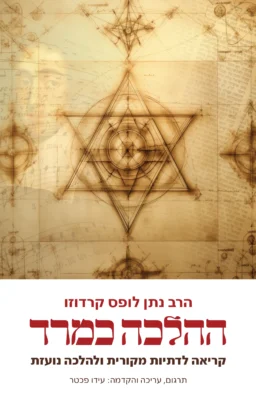
As mentioned in our last Thought to Ponder, my dear friend Rabbi Dr. Ido Pachter has provided an intriguing introduction to his Hebrew translation of my book: Jewish Law as Rebellion, A Plea for Religious Authenticity and Halachic Courage (Urim Publication, 2018). The book was published by Yediot Acharonot in May of this year under the title: ההלכה כמרד: קריה לדתיות מקורית והלכה נועזת
I have translated Rav Pachter’s introduction into English, Part 1 of which is included here. In the last Thought to Ponder, I wrote a review of the major ideas on which my book is founded, which will be helpful in reading Rabbi Pachter’s introduction.
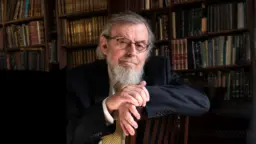
Nathan Lopes Cardozo
Rabbi Dr. Ido Pachter’s Introduction: Part 1
At first glance, attaching the phrase “rebellion” to the concept of “halacha” seems self-contradictory. After all, what is halacha; a sum of instructions, norms, and obligations that require a person to behave and act in a manner dictated to him from Above. Obedience and submission are the building blocks of halacha. Accuracy and strict observance of the religious deed are its purpose.
Ostensibly then, there is no rebellion in halacha; it is about coping. The opening words of the main code of Jewish law, the Shulchan Aruch, are “Rise up like a lion in the morning to worship your Creator.” When the halachic man begins his daily routine, he becomes involved with himself. He must subdue his impulses and instincts to submit to God’s service. Fighting fatigue, halacha calls on a person to overcome and stand up straight as soon as he wakes up. Combatting laziness, halacha requires us to become stronger and do what is right in the eyes of his Creator. The pursuit of halacha is one of devotion and submission to the law and divine service.
Rebellion is the opposite. Rebellion expresses disobedience, defiance, and lack of acceptance of authority. When Israel complains about Moses and Aaron after the sins of Korach and his congregation, God calls them “sons of rebellion”.[1] When the two and a-half tribes living in Transjordan build an altar for themselves, arousing the concern that they are deviating from God’s ways, they justify themselves by saying, “God forbid that we rebel against God.”[2] Isaiah and Ezekiel, in their exhortations, refer to Israel as the “people of rebellion”[3] and “the house of rebellion.”[4] Rebellion. In these instances, is a harmful crusade against authority, whether spiritual or political, and therefore is contrary to religious law, which is based on a hierarchical system that requires obedience and order. In halachic language, to refer to a person as a “rebel” is not complimentary, but derogatory.
In this respect, Rabbi Dr. Nathan Lopes Cardozo’s book, Jewish Law as Rebellion, which we now get to see published in Hebrew translation, contains an important and intriguing message, an intellectual vision, a religious perception and an educational concept of great depth. Already in the title of the book, Cardozo heralds the revolution he seeks to bring about in halachic consciousness, which is in fact the essence of the book. Instead of seeing the concept of rebellion as the antithesis of Jewish law, Cardozo argues that rebellion is the authentic nature of halakha, and that, in fact, anyone who does not understand halacha within this framework misses its great message.
It is important to note that Rabbi Cardozo is not the first to use the concept of rebellion in a religious context. Members of the Hapoel Mizrahi movement, established in 1922—led by Shmuel Chaim Landoy (Shahal), one of the originators of religious Zionism—sought to create a “holy revolt.” This slogan expressed the dissatisfaction of the younger generation in the Mizrahi movement with the stagnation of thought surrounding the movement’s leaders, and the need for spiritual freshness. Thus, the rebellion was not directed against the Torah, but was carried out for the sake of the Torah. Landoy did not fight the rabbinical authority of the time or distance himself from God, rather he wished to draw the movement closer to God.
Revolution, in general, is not foreign to Jewish tradition. Abraham is portrayed in the midrashim as a revolutionary, who eradicates idolatry and fights against it. The Exodus from Egypt is presented as a political revolution in the ancient world. The prophets were religious revolutionaries who advocated the priority of social morality over sacrificial worship, and often functioned as rebels against the government when rebuking kings for their crimes. Other revolutions accompanied the Jewish tradition at all stages of its development—from the editing of the Mishna by Rabbi Yehuda HaNasi to the growth of Orthodoxy under the leadership of Rabbi Samson Raphael Hirsch in Germany in the 19th century.
Still, it seems to me that Rabbi Cardozo’s rebellious thought is novel. If there were rebellions and revolutions in Jewish tradition, they usually appeared under the mantle of Jewish law but did not subvert it. The revolts took place in the cultural and ideological sphere, and at most they used halacha as a tool. Other revolutions took place in the manner in which halacha was shaped. But in all this, the basic consciousness of halacha remains the same—a set of norms to which man is obliged to agree and obey. Rabbi Cardozo disagrees. In his thought the very act of halacha is a movement of rebellion. When a person fulfills halacha, he puts himself in an offensive rather than defensive position, a position whose purpose is to undermine the accepted status quo and not to accept it. Halacha is a stimulating, rather than a silencing element; it creates a new reality not in agreement with what existed previously.
But how is this possible? How can the consciousness of rebellion dwell alongside a world based on commandments and laws? It seems impossible to understand this point without looking at Rabbi Cardozo’s life story, which is as fascinating as his thought.
We will explore this in our next post.
Notes:
[1] Numbers 17:2.
[2] Yehoshua: 22:29
[3] Isaiah 30:9.
[4] Ezekiel 2:5.

Rabbi Nathan Lopes Cardozo
Rabbi Dr. Nathan Lopes Cardozo is the Founder and Dean of the David Cardozo Academy and the Bet Midrash of Avraham Avinu in Jerusalem. A sought-after lecturer on the international stage for both Jewish and non-Jewish audiences, Rabbi Cardozo is the author of 13 books and numerous articles in both English and Hebrew. He heads a Think Tank focused on finding new Halachic and philosophical approaches to dealing with the crisis of religion and identity amongst Jews and the Jewish State of Israel. Hailing from the Netherlands, Rabbi Cardozo is known for his original and often fearlessly controversial insights into Judaism. His ideas are widely debated on an international level on social media, blogs, books and other forums.