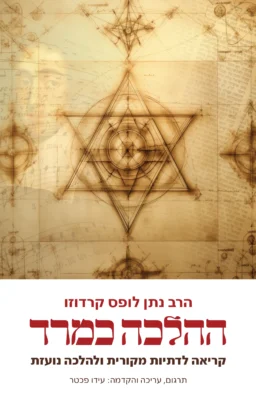
In our last Thought to Ponder we presented part 1 of Rabbi Dr. Ido Pachter introduction to the Hebrew translation of Jewish Law as Rebellion, A Plea for Religious Authenticity and Halachic Courage (Urim Publication, 2018). The Hebrew edition is titled
הלכה כמרד – קריה לדתיות מקורית והלכה נועזת
At the beginning of his introduction, Rabbi Pachter correctly questions my claim that Judaism in general—and Halacha in particular—can be seen as an expression of rebellion and protest. After all, to be religious means to submit to a higher Divine authority and the rule of law. Rebellion is the direct opposite; it is an expression of disobedience and a lack of acceptance of authority. How then can we claim that Judaism is a rebellion?
Rabbi Pachter admits that Biblical figures such as Abraham, Moshe, and others initiated a revolution against idol worship, immorality, and slavery, and that revolution is not a foreign concept to Judaism. But he goes on to say that according to my views on Halacha: “When a person fulfills Halacha, he puts himself in an offensive rather than defensive position, a position whose purpose is to undermine the accepted status quo and not to accept it. Halacha is a stimulating, rather than a silencing element; it creates a new reality not in agreement with what existed previously.”
But how is this possible? How can the consciousness of rebellion dwell alongside a world based on commandments and laws?
Rabbi Pachter suggests that in order to reconcile these two seeming opposites, one must understand my background and personal experiences, and how these have influenced my thinking. It is at this point that we pick up Rabbi Pachter’s narrative.
Nathan Lopes Cardozo
Rabbi Dr. Ido Pachter’s Introduction: Part 2
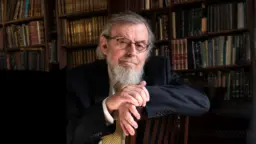
Rabbi Nathan Lopes Cardozo was born in 1946 in post-World War II Amsterdam. His father was Jewish, and his mother while not Jewish, was well acquainted with the world of “cultural” Judaism. After losing her parents at a young age, she had moved in with Rabbi Cardozo’s father’s family. The Cardozo family was secular, but like most Amsterdam Jews before the Holocaust, they maintained classic Jewish customs, such as having an elaborate meal on Friday night.
This reality placed Rabbi Cardozo in a complex secular Jewish consciousness. He knew he was of Jewish background and grew up with it in a non-Jewish environment. But halachically he was “not Jewish.” This complexity put him in the position of being both an insider and an outsider with relation to Judaism—a position that he carries with him to this day.
As he grew up, Rabbi Cardozo developed a sense of wonder. Questions about the essence and meaning of life, about human thought and understanding, as well as about his own fate, fascinated him. His heart was drawn to philosophy, and later this attraction turned into a religious awakening. He embarked on a spiritual-intellectual journey to resolve his inner turmoil.
As a member of an Amsterdam Jewish family, he began studying the works of Baruch Spinoza with his father. He searched for more books on Judaism. He found the Talmud in German translation and eagerly devoured the writings of the famous Rabbi Samson Raphael Hirsch. Slowly, he realized that his questions could best be answered through Judaism. Thus, he began observing some Jewish rituals—partially observing Shabbat and some of the laws of Kashrut—in order to experience and understand what they stand for.
Still, even when he entered the world of mitzvot—doubt about the truth of Judaism did not leave him. He was deeply influenced by Spinoza’s criticism of Judaism, and was not convinced that the Jewish Law stemmed from a Divine, rather than a human, source.
He writes that he learned to deal with this doubt through a dramatic encounter he had in the synagogue in Haarlem, twenty kilometers away from Amsterdam in the Netherlands. One day a young intellectual entered the synagogue, and called out to the congregants that all their praying was in vain because “God does not exist”. Immediately afterwards, the same man went to his seat, wrapped himself in a prayer shawl, and began to pray with great passion. Week after week, the same young man would repeat this ritual until Rabbi Cardozo could no longer hold back. He approached him and asked him what he was doing, why was he coming to the synagogue when he believed that there was no God? The man’s answer showed him that Judaism is much more than a belief in God and observing the commandments. He said:
Indeed I do not believe in God, but I do believe in Judaism. It is the greatest religion ever to appear on earth, it has contributed more to ethics than any other religion or culture, and we owe it to the world to keep it alive. If we Jews abandon it, the world will be so much the poorer. So I will come to synagogue, eat kosher and observe some of the laws of Shabbat. If I don’t, I will be guilty of destroying one of the most beautiful things the world has been blessed with. Whether or not it is God-given does not really interest me.[1]
This changed Rabbi Cardozo’s perspective on Judaism—and perhaps on life in general. He understood that you don’t have to solve all the big philosophical problems to recognize the great value of the Jewish tradition. He realized that Spinoza was mistaken in abandoning Jewish practice in the name of philosophy, especially because he did so out of a misunderstanding and sometimes deliberate misreading of Judaism and Jewish law. Had Spinoza received a proper Jewish education, he would have known that Judaism and Halacha were not just religious “behaviorisms,” and he might not have abandoned tradition.
But beyond that, Rabbi Cardozo has internalized a very strong religious consciousness, according to which heresy does not necessarily contradict faith; it can actually be part of it. “Even today I have my agnostic moments, especially when I am confronted with the intense suffering of children, such as in the case of terror attacks in and outside Israel,” he wrote in an autobiographical essay, “ For days, I can’t pray properly and I struggle with my belief in God. To this day, after a devastating terror attack I am astonished that religious Jews go to synagogue and instead of starting a demonstration against God they praise Him for His goodness.”
A deep belief in God does not negate doubt about Him, but continually co-exists with it. Heresy expresses man’s expectation to encounter a good, just, and honest world, and his dissatisfaction when the world is not characterized by these values. It is precisely the feeling of heresy that testifies to the vigilance of faith and God’s centrality in man’s world. Those who remain believers in every case and in every situation, those who continue a routine of prayer even when evil is rampant in the world, should be questioned whether they really believe. Faith is supposed to engage with life, not silence it. Faith is deeper than knowledge. Unlike knowledge, faith agitates the whole of man and transforms him.
Years after that encounter in the synagogue, Rabbi Cardozo devoted a short and provocative article to this tension between faith and heresy—an article about whether or not to wear a kippah. “My kippah is one of the main reasons for my failure to be religious,” he wrote candidly. For him, the kippah is a “bold religious act,” a kind of “declaration before God that I want to live in His presence.” But how can the kippah express this, if it is placed on the head every day, all the time? How can it be a stimulating experience when it is swallowed each day by the hair on one’s head? This situation leads Rabbi Cardozo to a paradoxical conclusion: In order to express his religiosity, he actually had to take off his kippah, just to experience wearing it again. Placing the kippah on his head is a religious experience. In practice, Rabbi Cardozo wears a kippah all the time, but only so that his grandchildren don’t think he wants to be less religious, when he actually wants to be more religious.
This tension between faith and heresy or, if you will, between religiosity and religion—is the tension at the heart of Rabbi Cardozo’s thought. It supports his concept of rebellion. For him the commandments themselves are expressions of rebellion and in fact much more.
But before we go any further, let’s return to his life story… which will be continued in the next posting.
[1] Nathan López Cardozo, “Lonely but Not Alone: An Autobiography of a Jew Who Should Not Have Been,” Conversations16 (Spring 2013), pp. 1–35. The article is available for reading on www.cardozoacademy.org website. It can also be read on the site in Hebrew translation, under the title: בודד אבל לא לבד אוטוביוגרפיה רוחנית קצרה אודות מסע לא שגרתי

Rabbi Nathan Lopes Cardozo
Rabbi Dr. Nathan Lopes Cardozo is the Founder and Dean of the David Cardozo Academy and the Bet Midrash of Avraham Avinu in Jerusalem. A sought-after lecturer on the international stage for both Jewish and non-Jewish audiences, Rabbi Cardozo is the author of 13 books and numerous articles in both English and Hebrew. He heads a Think Tank focused on finding new Halachic and philosophical approaches to dealing with the crisis of religion and identity amongst Jews and the Jewish State of Israel. Hailing from the Netherlands, Rabbi Cardozo is known for his original and often fearlessly controversial insights into Judaism. His ideas are widely debated on an international level on social media, blogs, books and other forums.