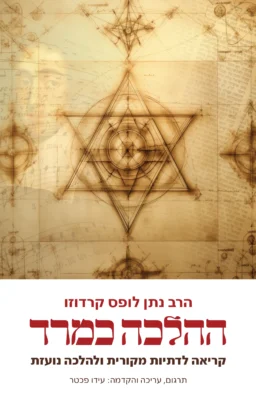
In our last Thought to Ponder we presented part 2 of Rabbi Dr. Ido Pachter introduction to the Hebrew translation of Jewish Law as Rebellion, A Plea for Religious Authenticity and Halachic Courage (Urim Publication, 2018). There, Rabbi Pachter discussed some of the earlier spiritual influences on my life and thinking. Among them are my readings of Spinoza and other secular philosophers and religious works such as those of Rabbi Samson Raphael Hirsch. Of particular importance was an encounter with a professed atheist in the synagogue in Haarlem, Holland. After declaring that “there is no God”, this man donned on his prayer shawl (tallit) and started to pray fervently. When I asked him why, he responded that indeed he did not believe in God but that he did believe in Judaism. He considered it the greatest religious and moral movement ever to exist and believed that it should never be lost. This encounter made an enormous impression on me and helped me, on several occasions, not to abandon the Jewish tradition even when I found myself struggling with my religious beliefs.
Rabbi Dr. Ido Pachter’s Introduction: Part 3
At the age of 16, Cardozo converted and became halachically Jewish. Many years later, after coming under the spell of religious Judaism, his mother also decided to convert. Thirty years after their civil marriage, Cardozo’s parents were married in accordance with Jewish Law by the rabbi of the Portuguese Spanish Community in Amsterdam. Cardozo’s parents’ Jewish wedding took place just three months before Nathan Cardozo’s own wedding to the woman he loved.
Nathan Cardozo has a brother two years his junior. In his youth there was a likelihood that also he would be the one to convert, but in the end he decided against it. An incident that occurred on the Seder night was probably part of this decision. This happened not long after Nathan Cardozo’s conversion, when he started to conduct the Seder at his parents’ home. At a certain moment his brother wanted to pour wine for those sitting at the Seder table. Nathan snatched the bottle from him and told him that it is forbidden for non-Jews to open a bottle of wine and pour from it, as the wine would be “cursed.” This, says Cardozo was a major mistake and an expression of great insensitivity on his side, as well as proof of his flawed halachic knowledge. Nowhere does it say that wine is “cursed” when a non-Jew touches a wine bottle. His brother was greatly insulted and sat down. This incident left in him a bitterness for the Jewish tradition. The implications of this story for Cardozo’s thought will be noted later.
After his conversion, Cardozo turned to in-depth Torah study in an ultra-Orthodox yeshiva in England, where he was later ordained as a rabbi. He was fascinated by the world of the beit midrash and immersed himself in a thorough study of the Talmud. But as the years went by, he felt that something was missing. Neither the rabbis nor the students thought about the larger questions that had laid the foundations of Judaism and Jewish life. They had no exposure to the broader philosophical literature, which brings into question the existence of God and the divinity of the Torah. They certainly did not have the knowledge to confront the teachings of Spinoza and refute him.
After 12 years, having gone on to earn a doctorate in philosophy, Cardozo immigrated to Israel with his wife and three children, eventually settling in Jerusalem. Cardozo was called upon to teach at a well-known “Baal Teshuva” yeshiva for newly observant Jews. He also lectured at a seminary for girls. But the pursuit of truth and the unwillingness to compromise his beliefs prevented him from continuing there. The rabbis of the yeshiva did not approve of his quoting non-orthodox thinkers, nor of his call for deep religious revival and renewal within orthodoxy. Ultimately, he was forced to step down. Interestingly enough, his fate was similar to that of another rabbi who also sought a religious awakening, and whose works greatly inspired Cardozo—Rabbi Abraham Joshua Heschel. The latter was a scion of Chassidic Judaism, became a professor in Jewish mysticism, and wrote some very profound works on Judaism. He too was rejected by some Orthodox rabbis, and with quite similar arguments—arguments often based on fear.
Cardozo realized that his ideas could be fully developed only if he was independent, and so he founded the David Cardozo Academy. At this institution he taught dozens of students, and at the same time established think tanks and directed programs for Jewish studies in various places. He became well known among a wider public—most of them English speakers—as a result of books and articles he published and various lectures he gave around the world.
In his autobiography, Cardozo writes: “I often wonder why God chose me to be born into this family, from a Torah-forbidden marriage, and why I had to encounter Judaism in such an unusual way.” But the answer to this is clear—his background gave him the ability to reach Judaism from the outside, in search of meaning, and to continue this search even after being absorbed deep within it. It developed in Cardozo a special view of Judaism, of which this book, Jewish Law as Rebellion, is a profound example. For him, Judaism, in all its aspects, is not something to be taken for granted, but is a profound religious movement that must continue to evolve in new ways that are deeply rooted in the tradition. It is this vision of Judaism that has been at the center of Cardozo’s work.
He summarized his life experience as follows:
A strong sense of mission overwhelms me. I realize that my life is different from most other people’s, including religious Jews. What I experience is the Hand from Above that gives me no rest and humbles me. I’m driven by it but do not always know where I am going. Often, I feel the need to step out of all this and start living a normal life. But, much as I have tried, it just doesn’t work. I am convinced that although I may never know what it is, there is great meaning behind this seemingly absurd life of mine. It is beautiful and demanding, yet quite frightening.[1]
In the next post Rabbi Pachter explains how I propose to understand Halacha as art.
Notes:
[1] Nathan Lopes Cardozo, Lonely But Not Alone – A Brief Spiritual Autobiography of a Jew Who Should Never Have Been, p. 65.

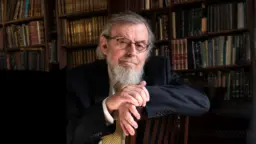
Rabbi Nathan Lopes Cardozo
Rabbi Dr. Nathan Lopes Cardozo is the Founder and Dean of the David Cardozo Academy and the Bet Midrash of Avraham Avinu in Jerusalem. A sought-after lecturer on the international stage for both Jewish and non-Jewish audiences, Rabbi Cardozo is the author of 13 books and numerous articles in both English and Hebrew. He heads a Think Tank focused on finding new Halachic and philosophical approaches to dealing with the crisis of religion and identity amongst Jews and the Jewish State of Israel. Hailing from the Netherlands, Rabbi Cardozo is known for his original and often fearlessly controversial insights into Judaism. His ideas are widely debated on an international level on social media, blogs, books and other forums.