Thoughts to Ponder
Is Halacha Always Indispensable?
The Tent of Meeting and the Danger of Organized Religion
In Halacha and Parashat Pekudei
One of the greatest dangers to religious life is organized religion—when religion turns into religious conformity and, in the case of Judaism, Halacha (Jewish law) becomes commonplace. At that moment it loses its excitement, vitality, and grandeur and becomes stale and dusty. It gets caught in a quagmire and morphs into behaviorism.
The first time we see this phenomenon is in the aftermath of the sin of the Golden Calf.
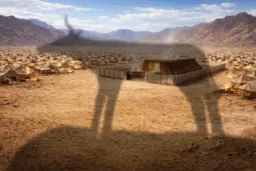
According to many commentators, the need to build the Tent of Meeting was the direct result of the breakdown of absolute monotheism that had been established through the great Divine revelation at Sinai.[1] In that revelation the unconditional prohibition against making any image of the Divine became sine qua non. There could be no compromise on this commandment.
Yet the very fact that there was a need for such a prohibition demonstrated that there was trouble brewing from the outset. The inability of humankind to live up to an uncompromising monotheism was hovering over all of Judaism. Even a thinker of the stature of Spinoza made this mistake when he declared that God and Nature (Deus sive Natura) are one and the same. In so doing he elevated nature to the level of God. For Judaism this is idolatry.[2]
The need for concrete expression
The incident of the Golden Calf proved the fragility of this prohibition. It showed that pure monotheism was too much for the Israelites to manage. They needed a tangible God, which was reflected in the creation of the Golden Calf. The worship of tangible deities, as the Israelites had experienced in Egypt, stuck with them despite the revelation at Sinai.
In response to the transgression, God does something very dangerous. Instead of enforcing the edict, He compromises on the prohibition.
After He “realizes” that His dream of absolute monotheism is asking too much, God introduces the requirement to build the Tent of Meeting—a variety of tangible monotheism that includes symbolic images in the forms of the Holy of Holies, the cherubim (golden angels on top of the Ark), the sacrifices, the altars, and more. All of these had originally been forbidden (see Seforno on Shemot 25:9).
Absolute monotheism did not work. It has to be lived on a lower spiritual level. This was the purpose of the Tent of Meeting.
But it also introduced the need for many more mitzvot as a means to compensate for the spiritual weakness of the Jewish people.[3] All this is part of the Divine compromise. Judaism slowly becomes an adapted and compromised religion, different from God’s original intention.
Tangible commandments such as tefillin—phylacteries that require a Jew to place these items on the forehead and the arm—were introduced, while originally they were meant to be completely spiritual: “You shall bind them (these Divine words) on your hand and as a sign between your eyes” (Shemot 13; Devarim 6).
And so it is with many other commandments such as the laws of kashrut and the laws of purity and impurity. All these laws were not necessary before the incident of the Golden Calf. They are all “negotiated” mitzvot, given in response to the Golden Calf.
Individualism and community
Concurrently, this began the development of an organized Judaism. There is now a central place of worship. The Jewish people become a community through collective conformity. No longer can the Jew live his spiritual life entirely on his own.
At Sinai each Jew was independent. Each could stand on his or her own feet before God. Each could observe the commandments individually. Everyone heard the Divine word according to his or her personality and could implement it personally (see Maharshal, Yam Shel Shlomo, introduction to Bava Kama).
But once monotheism was compromised, conformity became necessary. People could no longer stand independently. They needed each other’s help. God now would be found in the strength of the multitude—as in a symphony orchestra with diverse musical instruments.
But this also created a huge problem: Are all these commandments truly beneficial for all Jews? Could it be that some of them are actually harmful to some individuals?
In a highly unusual statement, Maimonides discusses this problem in his Guide for the Perplexed (III: 34):
Among the things that you need to know is the fact that the Law does not pay attention to the isolated individual. The Law was not given for rare occurrences… It is directed only toward what occurs in the majority of cases… In view of this consideration, you will not wonder that the purpose of the Law is not perfectly achieved in every individual. On the contrary, it necessarily follows that there should exist individuals whom the governance of the Law does not fit perfectly.
According to many, this observation means that in some cases certain mitzvot are of no benefit to particular individuals.
But it may be that Maimonides meant much more.
According to Rav Kook, it is possible that instituting religious law is itself a compromise—and that it could even be damaging.[4]
But this would hold true only for the spiritual elite; those individuals who were on the level of uncompromised monotheism as experienced at Mount Sinai before the giving of the mitzvot.
It is the masses who need the commandments. This should not surprise us. It is exactly what Chovot HaLevavot (Duties of the Heart) by Rabbeinu Bahya ibn Paquda (11th century scholar) seems to suggest. While many sources inform us that the patriarchs kept the commandments voluntarily—as if they felt the commandments from within—it appears that Rabbeinu Bahya believes they were not in need of commandments at all, since their spiritual level made them superfluous.[5]
Avraham, in particular, experienced God so closely that no medium in the form of mitzvot was required—not even voluntary ones.
In fact, as Rav Kook argues, commandments might even become damaging for such individuals, since they could become a spiritual impediment to souls that dwell on a level beyond the reach of commandments.
Two versions of Judaism
If so, there are now two Judaisms. The first is the original, pure, ideal Judaism—the one started by Avraham. Only a few commandments, such as circumcision, need to be observed. For the rest, a person can achieve spiritual connection on his own.
This may also explain why some traditions in Judaism state that the commandments will be canceled in the Messianic age (Nidda 61b; Shabbat 151b), when humanity will live on a far more exalted spiritual level.
There is even an opinion that what is now forbidden will be permitted in the Messianic era.[6]
In fact, the Talmud (Rosh Hashanah 35a) tells us that Rabbi Yehuda prayed only once every thirty days. The conventional explanation is that he was so occupied with the study of Torah that prayer would disturb him. But as Rav Kook suggests, it may very well be that prayer—and even Torah study—would hinder him in his absolute devotion to God.[7]
How interesting it is that the Talmudic sage Rabbi Zeira fasted for many days so as to forget the Babylonian Talmud (Bava Metzia 85a). Perhaps something similar may apply even to certain individual souls in our own days, for whom the observance of mitzvot is of no benefit—or perhaps even damaging. This seems to have been the opinion of Rav Kook, who may even have been referring to himself.[8]
Still, Rav Kook believed that even such spiritual giants must observe the commandments for the sake of strengthening the people of Israel. They must not be seen as deviators, and they must help uphold the general spiritual condition and unity of the Jewish people.[9]
The second Judaism is the compromised one. It is the Judaism we know today, which demands observance of all the mitzvot. The mitzvot exist to bring the Jew as close as possible to God.[10]
Yet this system is not without its problems. Do the commandments still bring us closer to God? The mere observance of commandments does not guarantee that they do. The same is true for many rabbinic laws. They are meant to strengthen the biblical commandments and make them more effective.
But do they always succeed? Often they do not.[11]
The only answer to this problem is a radical change in Jewish education. Rav Kook believed that the reason so many young people have departed from Judaism is that the great Torah leaders are in a “great slumber” and do not recognize what drives so many young people away from Judaism. Simply teaching a regular Talmud or Halacha class will not bring them back.
To draw on the beautiful observations of the poet Rainer Maria Rilke as a guide, Jewish education needs to be radicalized. To appreciate the real meaning of Torah, Talmud, and Halacha,
…one must see many cities, men, and things. One must know the animals, feel how the birds fly, and know the gesture with which the little flowers open in the morning. One must think back to roads in unknown regions, to unexpected meetings and to partings long foreseen… to mornings by the sea… to nights of travel under the stars… one must also have been beside the dying and have sat beside the dead in a room with the open window and the fitful noises… Only then can it happen that in a most rare hour the first word of a verse arises in their midst.[12]
All of this is necessary because the Talmud and Halacha are living evolving commentaries on the Torah text.
Only then—and not a moment earlier—do we glimpse olam she-kulo Torah, a world entirely permeated by Torah. Only then can we begin to understand what it means to be religious and practice the art of deciding God’s Halacha.
There is still a long way to go. It requires serious soul-searching within our religious world.
May we merit it!
Questions to Ponder
- Rabbi Cardozo suggests that the building of the Mishkan may represent a Divine compromise with human limitations. Why do you think people often prefer something tangible—such as a building, ritual, or object—when trying to connect with God?
- The essay warns that religion can sometimes become routine and lose its vitality. What are some ways we can keep our religious or spiritual practices meaningful rather than mechanical?
- At Sinai, the Jewish people experienced God directly, without a central place of worship. Later, many more commandments were introduced, including many social laws aimed at building a just society. Do you think these mitzvot would have been given even had the Golden Calf incident not happened? Why or why not?
Diving Deeper
Rabbi Cardozo suggests that the system of mitzvot and Halacha may represent a Divine accommodation to human limitations after the sin of the Golden Calf. Rabbi Joseph B. Soloveitchik offers a very different perspective. In Halakhic Man, he argues that Halacha is not a concession but a profound way of shaping reality itself. The halachic individual does not escape the world in search of God but instead sanctifies the world through concrete action and law. Likewise, our Sages taught “Hakadosh Baruch Hu wanted to refine Israel; therefore He gave them many mitzvot” (Makkot 23b).
How might Rav Soloveitchik respond to the claim that Halacha represents a “lower” spiritual level? Could it be that the detailed structure of mitzvot is actually the highest form of religious life, allowing human beings to partner with God in shaping holiness within the physical world?
Notes:
[1] See, for example, Seforno on Vayikra 11:2.
[2] Whether this is entirely true will depend on what Spinoza actually meant by Nature and by God.
[3] See Seforno on Vayikra 11:2.
[4] See: Pinkesei HaRe’iyah 4:395–396.
[5] See in particular Gate 3 (The Gate of Service of God – שער עבודת האלהים), Chapter 3 of Chovot HaLevavot.
[6] Midrash Shochar Tov on Mizmor 146:5.
[7] Shemona Kevatzim 2:34.
[8] See Marc Shapiro, Renewing the Old, Sanctifying the New, chapter 1
[9] Shemona Kevatzim 1:410; see also Mei HaShiloach by the Chassidic Rebbe Mordechai Yosef of Ishbitz on Bereshit 21:12, where he states that people sometimes have to “suffer” a mitzvah for the sake of their fellow Jews.
[10] Shemona Kevatzim 2:34.
[11] These ideas raise serious difficulties, including strong anti-nomian implications. There is a vast literature on this topic, though it is little known among the average religious Jew. Rav Kook, in his famous work LeNevuchei HaDor (For the Perplexed of the Generation), suggests that in the future the derashot—the hermeneutical interpretations of the Oral Law—may be reformulated in ways that could lead to changes in the mitzvot (chapter 13). See also Yehudah Behr Zirkind and Nathan Lopes Cardozo, “The Perfect Torah Versus the Evolving Torah (https://www.cardozoacademy.org/thoughtstoponder/the-ideal-torah-versus-the-evolving-torah/),”; and Shaul Maggid, Hasidism on the Margin.
[12] Rainer Maria Rilke, The Notebooks of Malte Laurids Brigge, trans. M.D. Herter Norton, in Rilke on Love and Other Difficulties (New York: W.W. Norton, 1975), 112–113.

Rabbi Nathan Lopes Cardozo
Rabbi Dr. Nathan Lopes Cardozo is the Founder and Dean of the David Cardozo Academy and the Bet Midrash of Avraham Avinu in Jerusalem. A sought-after lecturer on the international stage for both Jewish and non-Jewish audiences, Rabbi Cardozo is the author of 13 books and numerous articles in both English and Hebrew. He heads a Think Tank focused on finding new Halachic and philosophical approaches to dealing with the crisis of religion and identity amongst Jews and the Jewish State of Israel. Hailing from the Netherlands, Rabbi Cardozo is known for his original and often fearlessly controversial insights into Judaism. His ideas are widely debated on an international level on social media, blogs, books and other forums.