Thoughts to Ponder 844
Moshe’s Finest Hour
The Breaking of the Tablets
Many great leaders and thinkers have their single defining moment in history. Through these they will be remembered for generations to come. Albert Einstein is remembered for the discovery of the Theory of Relativity, Mikhail Gorbachev for the destruction of the Berlin wall, and David Ben Gurion for the declaration of independence of the State of Israel. There are many such examples.
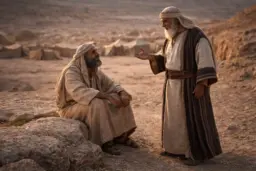
But it seems that there was no single moment which stands out in the lifetime of Moshe Rabbenu. Everything he did was far beyond the norm. Nearly all of his deeds were extraordinary. His leading the Israelites out of Egypt, the splitting of the Reed Sea, the receiving of the Torah at Mount Sinai, his personal audiences with God—they are all extra-ordinary.
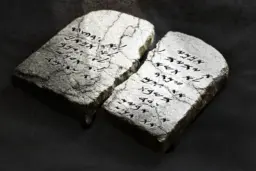
But our Sages, in a highly unusual statement, single out one deed of Moshe’s that surpassed all of these; the breaking of the Tablets as he descended from Mount Sinai as he found the Israelites engaged in the worship of the Golden Calf.
These tablets were engraved with the Ten Commandments by God Himself, and thus holier than anything else. And yet, when Moshe witnessed the idol worship by his people, he destroyed the tablets.
God did not command him to do this, nor did Moshe ask permission from God to do so. It was done on his own initiative, seemingly at the spur of the moment. No greater violation of God’s holy words can be imagined. No greater arrogance can be thought of.
But not only was Moshe never punished for this act of desecration, he is praised by God Himself! On the last verses in the Torah: “…and for all the great awesomeness that Moshe performed before the eyes of all of Israel.” (Devarim 34,10-12), Rashi comments on: “And for all great awesomeness…”, basing himself on the Sifri (357):
That his heart inspired him to break the tablets before their eyes as it says “and I smashed them before your eyes” (Devarim 9:17) and the mind of the Holy One blessed be He agreed with the mind of Moshe as it says “which you shattered” “asher shibarta” (the word “asher” in the plain meaning means “that” but is spelled the same as the word “to give approval”) which implies “yishar kochacha”, “I agree! May your strength be well directed” for having shattered the tablets.[1]
In other words, Moshe is not praised for a lifetime of accomplishments, but for one great initiative: the breaking of the tablets. This was Moshe’s finest hour; his single defining moment!
What was there in Moshe’s breaking of the tablets which outshone anything else he had done? What made this act the pinnacle of his life?
A deed of courage and foresight
When Moshe saw the Calf, he realized that the Israelites—despite witnessing open miracles, the splitting of the Sea, and the revelation at Sinai—had fallen into idol worship. Their past in Egypt still clung to them. If he now handed them the God-engraved Tablets, the commandments themselves could become objects of worship—a religious mantra in which form replaces faith. Even God’s own words, in such a moment, could be turned into an idol. Delivering the Tablets then would, in Moshe’s eyes, be extremely dangerous.[2]
The people were blocked—mentally and emotionally—by their past and by the immorality that had emerged from this worship. Small-mindedness had overtaken them to such a degree that nothing would help. Moshe therefore handed in, as it were, his resignation—by breaking the Tablets.
As we see so often even today, Israel had become like a herd of cattle, unable to think independently. That inability to think for oneself is, in essence, avodah zarah—idol worship.
When law becomes an idol
The deeper danger, which Moshe foresaw, is not limited to gross idolatry. Even in the hands of monotheists, Divine law itself can harden into an idol when observed, but not truly lived.
Religious people can hide behind commandments while evading what those commandments demand. As has been attributed to the Kotzker Rebbe, each grain of truth can be surrounded by shells of falsehood. We can “keep” mitzvot while insulating ourselves from their claims. If I observe today because I observed yesterday—simply repeating myself—I may be guilty of a subtle self-plagiarism. Words have souls; when the soul is gone, only a skeleton remains.
One can observe the commandments for the sake of a lie.
A law not written in stone
The corrective is constant renewal—not novelty for its own sake, but the refusal to let law ossify into habit. The Tablets, and its words, for all their sanctity, were susceptible to being seized as a fetish. Moshe’s act declares that nothing—not even the holiest artifact or commandment —may be allowed to eclipse the living God and His living Torah.
Novelty confounds rigid systems; when life changes, precedent can fail to supply the full truth of what God wants in the here and now. In such moments, fidelity to the letter of the law, without its animating spirit, leads to paralysis—or worse, to a pious betrayal of the Torah’s purposes.
The Ten Commandments, in their sublime simplicity, contain no narrative. They are law in its most cogent form. Without the music of meaning, they can be misheard. Moshe feared that a people fresh from idol worship would cling to the form of holiness and miss its soul.
Law needs its music: Torah’s narrative and spirit
This is why the Torah we were given is not only law (halachah) but also story (aggadah). Narrative supplies tone, context, aspiration—the melody that teaches us how the notes should be played. When law becomes rote, it becomes frozen. “Their fear of Me is a commandment of men learned by rote,” says the prophet.[3]
Because of this risk, the Written Torah alone cannot suffice. It must be accompanied by an Oral Torah that carries the law’s living intention across changing times. Chazal read God’s words, “Al pi ha-devarim”—“By the mouth of these words I have made a covenant with you”—to teach that the covenant was cut specifically through what is oral.[4]
“Lo bashamayim hi—It is not in heaven.” Halachah must be interpreted and applied by flesh-and-blood sages who, with fear of Heaven, take responsibility for reading God’s will into each new reality. That reading is not license to ignore the law; rather, it is the only way to be faithful to it.[5]
Breaking the Tablets was not a rejection of Torah but a defense of it. The act proclaimed: the Torah cannot be reduced to stone, to letters torn from their melody, to ritual torn from morality, to rule torn from relationship. The danger is when the law gets codified and frozen. Moshe’s greatness lay in knowing when fidelity to form would betray the essence—and in having the courage to act. God, the Giver of law, affirmed that courage: yishar kochacha sheshibarta.
The enduring challenge
Moshe’s shattered Tablets challenge every generation. Will we choose the ease of repetition over the labor of renewal? Will we worship our own pieties, or allow Torah to be what it is—a covenant that must be heard anew within the bounds of its words and the breath of its spirit?
It is remarkable that the second tablets were engraved by Moshe himself and no longer by God, teaching that a law that is to be lived can only be established by a Divine – human partnership.
By breaking the first Tablets Moshe saved Judaism from death by ice and death by fire—from freezing in awe of a rigid tradition and from evaporating into a utopian reverie.
Notes:
[1] Devarim 34:10–12; Rashi ad loc., citing Sifrei Devarim 357: “Asher shibarta… yishar kochacha sheshibarta.”
[2] Devarim 9:17
[3] Yeshayahu 29:13 (“mitzvat anashim melumadah”—rote practice).
[4] Gittin 60b (Vilna): covenant through the oral dimension; cf. Shemot 34:27.
[5] Bava Metzia 59b: “Lo bashamayim hi.”

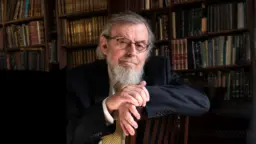
Rabbi Nathan Lopes Cardozo
Rabbi Dr. Nathan Lopes Cardozo is the Founder and Dean of the David Cardozo Academy and the Bet Midrash of Avraham Avinu in Jerusalem. A sought-after lecturer on the international stage for both Jewish and non-Jewish audiences, Rabbi Cardozo is the author of 13 books and numerous articles in both English and Hebrew. He heads a Think Tank focused on finding new Halachic and philosophical approaches to dealing with the crisis of religion and identity amongst Jews and the Jewish State of Israel. Hailing from the Netherlands, Rabbi Cardozo is known for his original and often fearlessly controversial insights into Judaism. His ideas are widely debated on an international level on social media, blogs, books and other forums.