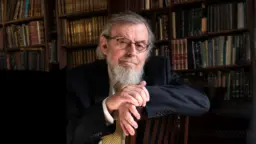
Thoughts to Ponder is a weekly invitation to think dangerously and question passionately. Drawing on the Torah portion, classical Jewish sources, philosophy, and the crises of contemporary life, Rabbi Cardozo challenges religious complacency and spiritual comfort. These essays are written for readers who seek a Judaism that disturbs, questions, and ultimately deepens the human encounter with God and responsibility.
As long as Judaism is taught as merely a luxury, something extraneous to life, it will be of little importance in the eyes of those who are asked to become Jewish. But when we teach it as being indispensable, it will become life itself and will make waves in the souls of all those we approach.
A parable on the future of Israel (Based on a fairy tale by Godfried Bomans adapted by Nathan Lopes Cardozo)
Once upon a time, in a large, gloomy palace high on a mountain, where the night wind groaned outside the massive walls, there lived a king, a real one. He had a long beard like a silver waterfall, and a voice like thunder. More a king does not need.
Although nobody can fathom the workings of the mind of God, from a religious point of view we must ask whether this silence and ambivalence are not the result of divine interference. Could we be losing our grip on this land because we have lost our way as the people of God?
Arbitrary Judaism is spreading in Israel. Halacha as the overall expression of Jewish commitment to a very specific lifestyle has nearly ceased to exist in the worldwide Jewish community. Judaism is often seen as an option, a tradition to choose from and to reject what is not to ones liking. One of the main reasons for this is that Halacha is no longer seen as response to the search for meaning in people's lives. The image of Halacha as a rigid tradition has taken the upper hand. It is seen as a desiccated remnant of a once living reality, which was reduced to definitions, codes and catechisms.
Rabbinical Tyranny and Freedom of Thought - The primary concern of Judaism is the art of living. To accomplish this goal it is committed to a strong sense of tradition and a determination to realize certain optimal goals. It is this road, which has made Judaism unique and makes it stand out among the community of religions. This unique directness from a historical past into a messianic future, from Mount Sinai to justice for the orphan, widow and stranger and the ultimate abolition of war has saved Judaism from death by ice and death by fire, from freezing in awe of a rigid tradition and from evaporating into utopian reverie.
Last week, hundreds of thousand of Jews throughout the world participated in the celebrations of Siyum Hashas, the completion of the Babylonian Talmud in a seven year cycle which was initiated by the great Torah scholar and tzaddik Rabbi Meir Shapiro z.l. of Lublin (1887-1934 ) Both in the past and at the present time, Jews from all religious and not so religious backgrounds have managed to study one daf, talmudic page, a day and so completed the Talmud, existing of about 40 volumes, once more. This is indeed a major accomplishment, unparalleled in the entire world of secular and religious scholarship. This is even more astonishing taking into account the fact that the Talmudic text exists (most of the time) of a cryptic Aramaic language, which is hard to decipher, even for scholars.
Nothing is more difficult than admitting a mistake, yet nothing is more human than making one.
In several places, the Torah deals with the need for and the merit of admitting one's mistakes. After all, a life spent making mistakes is not only much more honorable, but the alternative is much worse: The man who makes no mistakes is usually the man who accomplishes nothing. Only those who spend their time in total vanity are faultless. There is no road in between, and there is no escape. To own up to one's errors is greater than merely knowing how to avoid making them. It is wisdom that is gained.
Judaism is a religion of holy trivialities. Commonplace deeds are the moments through which man has the opportunity to meet God more intensively than at any other instant. Trivialities were created by God in order to show man that there are no insignificant moments and that every move of man counts, however small.It is God's opportunity to show man that He is concerned with every day of man's life and that every second counts.
And Moshes hands became heavy, so (Aaron and Chur) took a stone and placed it under him and he sat on it. And (Moshe held) his hands in steady prayer until the setting of the sun. Shemoth 17: 12
Religious Jewry and the Sanctification of God’s Name
When contemplating the terrible disaster which struck South East Asia and the amount of people which were killed and wounded as well as the millions of people who lost their homes, one is reminded of the words of Rabbi Naftali Tzvi Berlin: The obligation of Jews to shower infinite mercy on the world.
Parashanuth, the art of biblical interpretation, is far more than the ability to know how to give expression to the deeper meaning of the biblical text. It is after all impossible to treat the biblical text as any other classical work. This is due to the fact that the people of Israel, according to Jewish Tradition, are not the author of this text but that the text is the author of the people. The text consisting of a covenant between God and man brought the people into being and despite the fact that the people often violated the commanding voice of this text, it created a specific and unique identity of the Jewish nation.
Israel’s Uniqueness and its Future
Rabbi Yochanan ben Zakai once saw a woman stooping among the dung of the Arabs donkey to gather barley grains She said to him, Do you remember, Rabbi, when you signed my ketuva (1)?.... He said to his pupils, I remember that I read that it promised millions of gold dinars from you fathers house, apart from the wealth of your father in law. She began to cry. He continued, How praiseworthy are you, Yisrael. Whenever you perform Gods will, no nation can rule over you, but when you fail to perform Gods will, you are handed over to the lowest of nations, and not just to the lowest of nations, but to their animals. (2)