Thoughts to Ponder is a weekly invitation to think dangerously and question passionately. Drawing on the Torah portion, classical Jewish sources, philosophy, and the crises of contemporary life, Rabbi Cardozo challenges religious complacency and spiritual comfort. These essays are written for readers who seek a Judaism that disturbs, questions, and ultimately deepens the human encounter with God and responsibility.
Ido Pachter’s Introduction to Jewish Law as Rebellion – Conclusion
The essence of halakha is to go against the flow of routine. It trains us to find depth and meaning in every action. Through its guidance, all aspects of life gain new perspective, a sense of awe and elevation.
The Shofar, my Grandchildren, and the Sound of the Great Lion
We are God’s stake in human history and we could not make a greater mistake than to believe that we could ever be a nation like other nations. This is our great challenge. Will we remain complacent, letting the shofar sit in the cupboard, never daring to go beyond ourselves? Or will we have the nerve to blow the shofar and produce something which surpasses ourselves?
Ido Pachter’s Introduction to Jewish Law as Rebellion – Part 4
When I decided to study at the ultra-orthodox Gateshead Yeshiva, I learned that Judaism consists of a world view of tremendous depth, which is expressed in deeds and rituals that penetrate the deepest dimensions of the human being. I discovered Judaism in a different way than my fellow Yeshiva students did. They had grown up within Judaism, and thus were not able to see it from the outside as I did. They were so used to the splendor of Judaism that they were blinded by it and so no longer could they perceive it. At a later stage of my life, I myself fell victim to this same problem. I realized that I had lost my earlier fascination and had to start all over again. In this essay, Rabbi Pachter explains how I tried to do this.
Ido Pachter’s Introduction to Jewish Law as Rebellion – Part 3
This week we continue with Rabbi Dr. Ido Pachter's Introduction to the Hebrew translation of Jewish Law as Rebellion. In this week's excerpt, Rabbi Pachter discusses how Rabbi Cardozo's experiences as an outsider contributed to his unusual views on halacha and faith.
Ido Pachter’s Introduction to Jewish Law as Rebellion – Part 2
Rabbi Ido Pachter explains how Rabbi Cardozo's upbringing--in particular one memorable encounter with a fervent atheist in synagogue--influenced his unique take on faith and Jewish tradition.
Ido Pachter’s Introduction to Jewish Law as Rebellion – Part 1
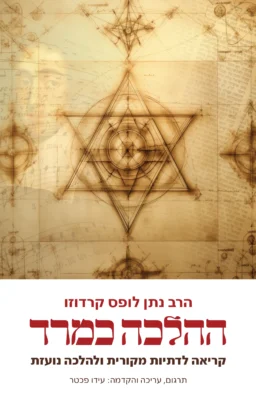
Rabbi Dr. Ido Pachter has provided an intriguing introduction to his Hebrew translation of my book: Jewish Law as Rebellion, A Plea for Religious Authenticity and Halachic Courage (Urim Publication, 2018). The book was published by Yediot Acharonot in May of this year under the title: ההלכה כמרד: קריה לדתיות מקורית והלכה נועזת
I have translated Rav Pachter’s introduction into English, Part 1 of which is included here.
A Summary to Nathan Lopes Cardozo’s new Hebrew book: Halacha Ka-Mered
Rabbi Pachter’s new introduction to the Hebrew edition of Jewish Law as Rebellion is very helpful in facilitating a better understanding of the book and of my philosophy. I have translated it into English from the original Hebrew and will be posting it in the coming weeks. To increase the clarity of some of the ideas, I am posting here a kind of “introduction” to Rabbi Pachter’s introduction for those who are not familiar with my perspective on Judaism and Halacha.
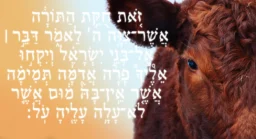
Parashat Chukat – The Red Heifer and the Meaning of Life
This week’s parashah opens with the perplexing law of the Red Heifer, whose ashes purify one who has come into contact with the dead. This strange ritual requires that “a red cow without blemish, in which there is no defect and on which no yoke has been laid” be slaughtered, then burned and its ashes mixed with water. This water would be held in reserve to be sprinkled over an individual who had come into contact with a corpse and was consequently ritually “impure”. Even stranger is the fact that the priest who prepares this purifying water, by his involvement with the preparation process, become impure!
This law is held up as the exemplar of a “Chok”—a commandment for which no obvious rationale can be found. Such a law is very different from the “Mishpatim”—those commandments whose moral or intellectual underpinnings are clear and reasonable. What are we to make of this “irrational law” of the Red Heifer?
After this war is won, the next great challenge facing the State of Israel will be the possibility that its soldiers will one day refuse to serve and defend this country. How long will we be able to rely on the Israeli army if its combatants do not realize what it is they are fighting for? It is important that they know that they are defending an idea and a holy mission which far surpasses the defense of a piece of land!
Shemita – The Blessing which can turn into a Curse
After God commands the Israelites to leave the land barren in the seventh year and not work it, God tells them that they should not worry that they will not have food in the seventh year and the following ones, because He will bless the sixth year with a crop sufficient for three years. With the establishment of the State of Israel God has not re-introduced the blessing of the sixth year. The law is still a rabbinic one, and thus it is possible to apply leniencies to make it easier to observe the shemita law. The question is: why has this blessing of abundance in the sixth year not been renewed?
The Jewish Tradition has two different words for freedom: “Chofshiut” and “Cherut”: Chofshiut means to be free from physical bondage, such as when a slave becomes free from his master. While he is physical free, he is not morally free. True freedom is found only within the rule of moral law.
The State of Israel should give birth to moral liberty, not just physical freedom. Physical freedom can be lost when others take it away, but moral freedom can never be stolen, since it is found in the heart and deeds of those who commit to higher aspirations as found in the Jewish Tradition.
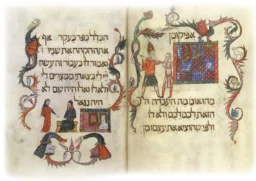
As Pesach approaches, there is something very important that we must understand. It is that the wicked son in the Haggada is in fact the wisest and most honest of the four sons. Why? Because he is the one who is asking the most important question of all!