Thoughts to Ponder 809
Parashat Chukat – The Red Heifer and the Meaning of Life
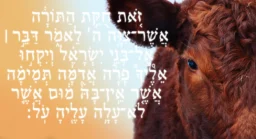
This week’s parashah opens with the perplexing law of the Red Heifer, whose ashes purify one who has come into contact with the dead. This strange ritual requires that “a red cow without blemish, in which there is no defect and on which no yoke has been laid” be slaughtered, then burned and its ashes mixed with water. This water would be held in reserve to be sprinkled over an individual who had come into contact with a corpse and was consequently ritually “impure” (tame).[1] Even stranger is the fact that the priest who prepares this purifying water, by his involvement with the preparation process, become impure![2]
This law is held up as the exemplar of a “Chok”—a commandment for which no obvious rationale can be found. Such a law is very different from the “Mishpatim”—those commandments whose moral or intellectual underpinnings are clear and reasonable.
What are we to make of this “irrational law” of the Red Heifer?
The certainty of uncertainty
Contact with the dead undermines our sense of security. It reminds us of our vulnerability. Perhaps this is why one who has come into contact with a corpse is “ritually impure” and is not allowed to bring a sacrifice to the Temple. Such a person is depressed—not clinically depressed perhaps—but nonetheless, he has been brought into contact with his own vulnerability and may feel that the bottom has dropped out of his world.
Nor is this kind of depression uncommon. There are many people who feel that they are missing something fundamental in their lives—who lack a sense of higher meaning. This void darkens their lives and they feel depressed.
What is common to many such people is that they are looking for meaning in the wrong places! Reason does not offer these people sufficient grounds to believe in a higher purpose. Sometimes their reason moves them in the opposite direction.
Meaning beyond reason
And yet, there are matters in life that surpass reason. I cannot explain why I love my wife, why I am deeply impressed by nature, why I am moved by music, why the night sky with its millions of stars overwhelms me, or why I am overcome with emotion when holding a newborn baby with all its tenderness and sweetness.
I also do not know why at times my conscience tells me that certain things are morally wrong, even lacking a good reason to justify this instinct.
All these experiences are extraordinary. They belong to an all-together different category than what reason can touch or relate to. They are rooted in something within us that creates a need “to look up”—an awareness of that which is radically different. What this “something” is, we cannot put into words. These feelings and emotions are ineffable. However, all these sentiments make our lives warm and romantic, and they are capable of lifting us out of our routine, run-of-the-mill experiences, which are often cold.
Awareness of something higher is shared by every human being—religious and atheistic alike. Should someone maintain they have no such feelings, they are probably in denial, because these feelings are the very stuff of which we are made. We have an inborn awareness for hope and joy. It is a need for a relationship that surpasses us, without which we would be alone—which is one of the worst conditions a human being can experience.
But we cannot explain any of this in rational terms.
The secret of the Red Heifer
This is the secret of the unique ritual of the Para Aduma, the Red Heifer. The entire ritual is completely non-rational as far as our intellect is concerned. It exemplifies by its very nature the fact that not everything has a rational answer. How can the ashes of the Red Heifer purify a person? And for that matter, is it not paradoxical that the priest who sprinkles the ashes himself then becomes impure?
Asking these questions is the wrong way to go about it! Indeed, our intuition recognizes that not everything is accessible to our reason. Our experience of emotions, and our appreciation for beauty teach us that these incorporeal elements are just as real as the concrete facts of scientific knowledge.
I am reminded of the statement by the Swiss author and dramatist, Friedrich Durrenmatt: “He (who) confronts the paradoxical exposes himself to reality.”[3] We need to accept the paradoxical as a fact of life. It is the fluid foundation of all existence.
That is why rituals such as that of the Red Heifer are of outmost importance. They reveal a dimension in our lives which we are otherwise not aware of. Their purpose is to make us aware of the feelings that are often deeply embedded in us, and only through the ritual become more tangible. There is no other way to get to them.
Indeed, in the words of Abraham Joshua Heschel:
The search of reason ends at the shore of the known… reason cannot go beyond the shore and the sense of ineffable is out of place where we measure, where we weigh… We sail because our mind is like a fantastic seashell, and when applying our ear to its lips, we hear a perpetual murmur from the waves beyond the shore.”[4]
Notes:
[1] See Bamidbar 19.1.
[2] Bamidbar 19:7.
[3] Friedrich Durrenmatt, “21 points”, the Physics, 1962.
[4] Abraham Joshua Heschel, Man Is Not Alone: A Philosophy of Religion.

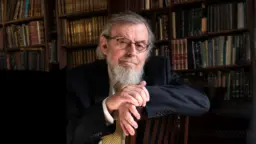
Rabbi Nathan Lopes Cardozo
Rabbi Dr. Nathan Lopes Cardozo is the Founder and Dean of the David Cardozo Academy and the Bet Midrash of Avraham Avinu in Jerusalem. A sought-after lecturer on the international stage for both Jewish and non-Jewish audiences, Rabbi Cardozo is the author of 13 books and numerous articles in both English and Hebrew. He heads a Think Tank focused on finding new Halachic and philosophical approaches to dealing with the crisis of religion and identity amongst Jews and the Jewish State of Israel. Hailing from the Netherlands, Rabbi Cardozo is known for his original and often fearlessly controversial insights into Judaism. His ideas are widely debated on an international level on social media, blogs, books and other forums.