Announcing the Cardozo Academy Writers Guild!
Due to the war in Israel and other circumstances, I have asked Yael Shahar, the well-known author of Returning, and member of our Think Tank and Writer’s Guild to share with me the penning of the weekly Thoughts to Ponder Series. These essays are written in the spirit of the Cardozo Academy and with my full approval.
I thank her very much!
Nathan Lopes Cardozo
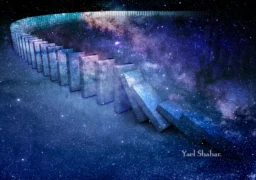
One of the more perplexing aspects of the Exodus story is the repeated “hardening” of Pharaoh’s heart. This phrase—together with another that is equally mysterious—is the key to understanding the true miracle of the Exodus.
Variations on this enigmatic phrase appear nine times in the story of the Exodus; at times, Pharaoh is said to harden his own heart, while at others, God is the one “strengthening” the monarch’s resolve. Does this mean that Pharaoh has no free will? And if he does not, then why is he, his household, and the entire Egyptian society punished by plague after plague?
In fact, virtually every encounter with Pharaoh involves a dialog between two key concepts: the hardening of the heart is paired with God’s showing Pharaoh, the Egyptians, or the Israelites “that I am Hashem.” Why is it so important that the Egyptians learn the mysterious name of God? Surely the primary target for this lesson would be the Israelites themselves!
The solution to both questions is bound up in the true miracle of the Exodus—and it isn’t what we commonly think!
Rationalizing miracles
When Moshe and Aaron first approached Pharaoh, they didn’t request an end to the enslavement of the Israelites. Instead, they requested that the slaves be given time off for a religious festival—a seemingly modest request. Pharaoh’s answer was a firm No: “Pharaoh’s heart was hardened, and he did not listen to them.” With every subsequent encounter, Pharaoh compounded this first mistake by becoming further entrenched in his determination not to let the slaves go free, even for a brief holiday. Each escalation led him to harden his resolve; his mindset had become his prison.
The fact that Aharon and Moshe started out with easily replicated tricks played into this entrenchment: once assured that his own magicians could reproduce their “signs and wonders”, Pharaoh had no reason to believe that anything unusual was afoot. The challenge to the status quo could be reasoned away.
Even when things escalated to a plague of lice, which Pharaoh’s court wizards were unable to reproduce, Pharaoh continued to “strengthen his heart”—habits of thought are hard to break. Only when a plague struck which the court wizards not only couldn’t reproduce, but from which they couldn’t even save themselves, are we told that God strengthened Pharaoh’s heart.
The necromancers could not stand before Moses because of the boils, for the boils inflicted the necromancers and all Egypt. But God strengthened the heart of Pharaoh, and he would not heed them, just as God had told Moses.
The Midrash Rabbah (Exodus Rabbah 11:6), noting the change of language, says:
When God saw that Pharaoh did not relent after the first five plagues, He said: Even if Pharaoh now wished to repent, I shall harden his heart, in order to exact full punishment from him.
The trap of conviction
Pharaoh’s problem is known to psychologists as confirmation bias: once a way of thinking becomes habituated, each time we resist change, we further lose our ability to see contradictory facts. Or, in the words of our sages: “In the way that a person wants to walk, he is led.” (Talmud Bavli, Makkot 12a)
Pharaoh’s dismissal of the evidence at hand—at first a conscious act—was now out of his hands; he had become a slave of his own stubbornness and could no longer see what was obvious to everyone else.
There is a lesson here about how those in power rationalize their decisions—even disastrous decisions—in order to avoid acknowledging past mistakes. Pharaoh continues to resist even to the extent where his servants implore him: “How long will this be a barrier to us? Let the people go and they will worship their God. Don’t you yet know that Egypt is lost?”
The question of free will
So, returning to our initial question of whether Pharaoh did or did not have free will we find that the answer is both “yes” and “no”. Pharaoh and his society were caught up in a process in which each ill-conceived decision bred another calamity, and yet they could find no way out of the cycle. Again and again, God “strengthens the hearts” of the Egyptians—first, so that they would refuse to free the slaves, and later so that they would pursue them to bring them back. The impression throughout is that no one was really acting from free will.
But how do we reconcile this seeming lack of free will with the Torah’s usual insistence that humans are free to choose?
I think an answer is to be found in the Torah’s depiction of miraculous events. Consider how the Torah describes the splitting of the Reed Sea in next week’s parashah: the text pictures the waters standing on either side like a wall, but we are also told that God performed the miracle via a strong east wind that blew all night. The miracle might easily be ascribed to a natural—if freakish—occurrence.
So too, had we not been told explicitly that it is God who is “stiffening Pharaoh’s heart”, we would see his disastrous decisions simply as spectacularly bad leadership brought about by confirmation bias and an arrogant nature that is incapable of admitting mistakes. But if we choose to see God’s hand in causality—including in the laws of psychology—then we can appreciate that confirmation bias was the method by which God stiffened Pharoah’s heart.
In giving us the “inside scoop” the Torah is teaching us that there are different ways of seeing things; the same event can be viewed through more than one lens. We can see it as a natural phenomenon, which of course it is. Or we can see it “from the inside” as part of a larger plan. Both ways of seeing things are true. They each represent one aspect of a world whose Creator names Himself as “I will be as I will be”.
The sages of the Talmud famously stated (B’rachot 33b): “All is in the hands of heaven, except the fear of heaven.” Even when free will seems to be lacking, which lens we use to view the world is our choice.

Yael Shahar
After an adventurous and unattributable career in security and intelligence, Yael Shahar now divides her time between writing about Jewish philosophy and learning Talmud with anyone who will sit still long enough. She is the author of Returning, a remarkable true story of spiritual resilience. Her writing on Jewish history and philosophy can be found at www.yaelshahar.com.