From the Cardozo Academy Writers Guild
Growing up, I was never particularly artistic. Even today too, at parents’ evenings in my daughter’s school, when the teachers bring out paint brushes and ask us to participate, I wonder why I didn’t send my wife instead. But there was one school project that I distinctly remember even 35 years later—making our own Hagaddah. With large doses of help from my creative and generous parents, I won the school prize.
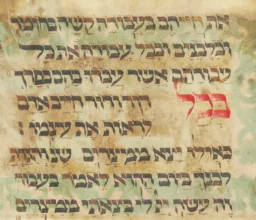
Looking back, I vividly recall the page for VeHee SheAmdah.
|
והיא שעמדה לאבותינו ולנו. שלא אחד בלבד עמד עלינו לכלותינו. אלא שבכל דור ודור עומדים עלינו לכלותינו והקדוש ברוך בוא מצילנו מידם. |
This is what stood by our ancestors and us. For not only one (enemy) has risen up against us to destroy us. But bechol dor vador (in every generation) they rise up to destroy us. And the Holy One, Blessed be He, delivers us from their hands. |
We drew a large red-brown wall comprising an array of bricks, each one inscribed with a different enemy. It was a systematic creation of an all-star team of baddies—Crusaders, Spanish Inquisitors, Cossacks, Nazis. To make it contemporary, and to remain true to the meaning of the text—that the Jewish people have enemies in every generation—we added the Palestinian Liberation Organization, the latest in a long line of villains trying to destroy us.
At that stage I was not theologically troubled by the final part of the paragraph—that the Holy One delivers us from their hands. That would come later.
That bechol dor vador is not the only time the phrase “in every generation” appears in the Hagaddah. An integral part of the night’s reading includes how “in every generation each person is obligated to see themselves as if they left Egypt”.
Freedom is thus not just past history but present reality. Not solely his-story but my-story.
In his book Exodus and Revolution, American public intellectual Michael Walzer writes of the contemporary political meaning of the exodus from Egypt:
So pharaonic oppression, deliverance, Sinai, and Canaan are still with us, powerful memories shaping our perceptions of the political world… this is a central theme in Western thought, always present though elaborated in many different ways. First, that wherever you live, it is probably Egypt; second, that there is a better place, a world more attractive, a promised land; and third, that the way to the land is through the wilderness. There is no way to get from here to there except by joining together and marching.[1]
The story of freedom is timeless, and certainly according to Walzer, universal. In different ways, each of us is on what Nelson Mandela called the long walk to freedom, on our way to a promised land.
The Hagaddah commands each of us to undertake this journey of liberation. But what are the ingredients for a successful process?
The late emeritus British Chief Rabbi, Jonathan Sacks, points to a curious text in Shemot relating to the Israelites asking their neighbors for gold and silver before they left Egypt.
Then the Lord said to Moses, “One last plague will I send against Pharaoh, against Egypt. After that, he will send you forth from here, and when he does, he will drive you out completely. Now tell the people, men and women, to ask of their neighbours articles of silver and of gold.” (Ex. 11:1-2)
The scenario sounds like an antisemitic joke. Those stingy Jews had no time for their bread to rise but they did find time to demand generations of unpaid wages. Sacks compares this story to the case of a redeemed slave who is given gifts before going free, which he explains allows the former slave to leave without a hint of anger and without a sense of humiliation. This process of giving and receiving helps to facilitate emotional closure. One who has received gifts finds it hard to hate. And hatred prevents true freedom.
“A people driven by hate” writes Sacks, “are not—cannot be—free.”
Had the people carried with them a burden of hatred and a desire for revenge, Moses would have taken the Israelites out of Egypt, but he would not have taken Egypt out of the Israelites. They would still be there, bound by chains of anger as restricting as any metal. To be free you have to let go of hate.[2]
There is a tension here. If “in every generation” we are commanded to liberate ourselves from slavery, then surely we’re also obligated to relieve ourselves of any hate (and fear) towards those who wronged us. But we also tell of how “in every generation” enemies rise up against us. Those two “in every generations” clash. Too much focus on the first (our enemies) undermines our ability to do the second (overcoming hate). Emphasizing the second (no hate) may dull our senses to the reality of the first.
As I grew up, I wondered whether despite being physically free, many Jews were still emotionally enslaved or overly traumatized by the past; that even though we had an independent and powerful sovereign state, our predominant vision was that of a world out to get us. I felt that many erroneously held a view of the past described by the great 20th Century Polish-Jewish historian Salo Baron, who wrote about a “lachrymose conception of Jewish history,” which viewed “the destinies of the Jews in the Diaspora as a sheer succession of miseries and persecutions.”
The Jewish reality—I then believed—had changed. As American-Israeli author Daniel Gordis argues: Zionism believed that it could change Jewish history, while American Judaism thought it could escape Jewish history.[3] In other words, those stories from our history (and grandparents)—of parents hiding their children in a cupboard, or children smearing blood on themselves and playing dead as Einsatzgruppen continued their killing spree—were just that.
Stories.
From the past.
In this understanding, our present was (unnecessarily) dominated by the idea that “in every generation they rise up to destroy us.” This prevented us from “in every generation” seeing ourselves as leaving Egypt, which includes the idea that, by letting go of hate we become truly free.
Then we experienced the barbarism and evil of October 7. Those Jews—both in Israel and the diaspora—who had optimistically believed that the direction of Jewish history had fundamentally changed were shocked. They / we had been mistaken. Friends of mine, a Jewish couple living in the mixed Jewish-Arab city of Jaffa, told me of discussions about finding an Arab metapelet / care-giver for their baby daughter. “If they come for us like on October 7,” they imagined, “at least there is a chance the metapelet will take pity on the baby and save her.”
Micah Goodman described October 7 as the Jewish people receiving a “greeting” from Jewish history.[4] Or as we might frame it, the pendulum has violently swung back towards “in every generation they rise up against us.”
Many of us are currently deep within the “in every generation” that refers to our enemies. We are justifiably filled with rage towards those of our neighbors who are genocidal jihadists, who have promised to repeat their slaughter whenever given the opportunity (it’s worth pointing out that some diaspora progressives responded to October 7 by focusing on the “in every generation” that refers to not hating.)
The challenge for all of us—like so many generations of the Jewish past—is to hold on to both versions of “in every generation”: The memory of the danger, with the commandment to ultimately overcome our anger. This isn’t easy. Even though we have a sovereign state of Israel, we still haven’t reached the Promised Land. As Walzer reminds us, we will need to journey through the wilderness. May this Pesach mark a positive step along that journey—of remembering the past (and present), without allowing it to control us.
Notes:
[1] Michael Walzer, Exodus and Revelation (Basic Books 1986) p 149.
[2] Rabbi Jonathan Sacks, Covenant and Conversation: Exodus (New Milford, CT: Maggid Books, 2010), p. 93.
[3] Daniel Gordis. “October 7: The Return of History”, https://jewishreviewofbooks.com/american-jewry/17210/october-7-the-return-of-history/
[4] Micah Goodman, Mifleget haMachshavot Podcast (Hebrew), episodes 73, 74 & 75

Calev Ben-Dor
A former analyst in Foreign Ministry, Calev Ben-Dor has worked in the Israeli policy and national security world for over 15 years. He is currently Editor of the <i>Fathom Journal</i> and has vast experience in lecturing and teaching about Jewish texts, Israel, and the Middle East to different groups.