Skip to content

Writer’s Guild

The Cardozo Academy Think Tank opens its doors to voices that probe, question, and illuminate. These essays reflect rigorous thought, spirited debate, and deep engagement with Torah and lived experience. Readers will find essays that challenge preconceptions, explore timeless themes, and make meaning out of the complexity of faith and culture.

  • The Disputation in Barcelona: Theatrical Challenges

    By Yael Valier

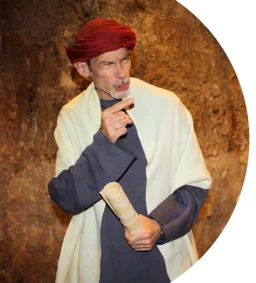
    In the context of the launch of a new theater company whose mission is to bring entertaining theological content to audiences in and around Jerusalem, Roy Doliner’s Divine Right was chosen as the company’s first production. This play about the Disputation of Barcelona balances historical accuracy and creative dramatic content in a satisfying and intellectually honest portrayal of the events of the Disputation for educated lay audiences. This paper examines the technical, dramaturgical, and theological issues that arose during this production for the playwright, director, actors, and audiences.

  • The Perfect Torah Versus The Evolving Torah – Part 7

    By Yehuda DovBer Zirkind

    This is the last of a seven-part series on the thoughts of the Mei HaShiloach, the famous and highly unusual work by the Chassidic thinker, Rabbi Mordechai Joseph Leiner of Izbica. In this essay, Yehuda DovBer Zirkind discusses how the ideas of Mei HaShiloach may impact the future evolution of halachah. Many observations by the Mei HaShiloach touch on my opinion that Halacha will have to liberate itself from what we can only call “Defensive Halacha,” which became the norm while the Jewish people were living in exile.

  • The Perfect Torah versus The Evolving Torah – The Philosophy of The Mei HaShiloach and Its practical Consequences

    By Yehuda DovBer Zirkind

    This is the sixth part of our discussion on the philosophy of the Chassidic thinker, Rabbi Mordechai Yosef Leiner of Izbica, author of the Mei HaShiloach, a most unusual work which in many ways goes far beyond the established norms of orthodox Halacha as we know it today. Yehudah DovBer Zirkind continues to discuss Rav Cardozo's observations, and adds much important information and insights of his own.

  • The Perfect Torah Versus the Evolving Torah – Part 5

    By Yehuda DovBer Zirkind

    The Mei HaShiloach’s highly unusual teachings are becoming more and more relevant in our days, as we face greater challenges to Halacha and the Jewish lifestyle. Among these challenges are the establishment of the State of Israel, numerous religious crises, and the challenge of modernity. Can Halacha—which can no longer rely on the strict adherence to its rules, but gets more and more dependent on its ideological and spiritual message and spirituality—guide us in the future?

  • The Perfect Torah Versus the Evolving Torah – Part 4

    By Yehuda DovBer Zirkind

    In these trying times, it is of great value to focus on spiritual matters that may move us to a different plain. This will give us comfort, broaden our minds and enlarge our souls, as we carefully follow all the health regulations prescribed by our authorities. Here is the fourth part of Yehudah DovBer Zirkind’s reflections on the ideas of the Mei HaShiloach and my own comments.

  • The Perfect Torah Versus the Evolving Torah – Part 3

    By Yehuda DovBer Zirkind

    The two different approaches to the Torah: the “perfect Torah” and the “evolving Torah” approaches are related to a broader theological question about the nature of the mitzvot: Do the mitzvot reflect God’s ultimate and unconditional will (kvayachol), or do they reflect God’s instrumental will for humanity, providing an instruction manual for how to redeem the world? In other words, is the main purpose of the mitzvot for the sake of God (i.e. that humankind should fulfill God’s wishes) or for the sake of man (i.e. that God’s plan for humanity should be realized)?

  • The Perfect Torah versus the Evolving Torah – part 2

    By Yehuda DovBer Zirkind

    The giving of the Torah has radically altered the course of Judaism and we cannot revert to a pre-Torah age. Nevertheless, Rabbi Cardozo believes that the vision and spirit of this formative era, i.e. the vibrancy of an inchoate and incipient Judaism - or to borrow a metaphor from biology, a “stem cell” based Judaism - should be kept alive and maintained as a counterweight against the ethos of textual fixation and rigid Halachic codification which is so prevalent within the contemporary Orthodox Jewish world.

  • The Perfect Torah vs. the Evolving Torah

    By Yehuda DovBer Zirkind

    Part 1 of a series discussing the ideas of the Chassidic master, Rabbi Mordechai Yosef Leiner of Izbica, Poland (1800-1854), also known as the Mei Hashiloach, after the title of the book containing his teachings.

  • Learning to be finite

    By E.S.

    Spiritual experiences may represent our yearning for the “infinite”, but this yearning can only find expression in seeking to improve ourselves to the best of our ability and seeking to relate with love to the people and the world around us, while at the same time coming to an acceptance of our finiteness and separateness, overcoming the grief and outrage we feel at not being everything. Yearning for the infinite is really a way of learning how to be finite.

  • On Spiritual Experiences – A response to Yael Valier

    By Michael Kagan

    Religious experience is not necessarily any more valuable than purely spiritual experience. A vital part of the defining genius of the Jewish tradition is that it produced an intricate set of observances which, together, create an experiential space which is hospitable to spiritual experience and, to an extent, stimulates it.

  • What makes a “spiritual experience”?

    By Yael Valier

    What turns a spiritual experience into a religious one is the training and preparation that creates a religiously shaped receptacle for an experience or at least a religious vector for channeling the experience.

  • The Legacy of Rav Soloveitchik

    By Yehuda DovBer Zirkind

    In evaluating Rabbi Cardozo's critique of Rav Yoseph Dov Soloveitchik, it is important to clarify that Rabbi Cardozo criticizes Rav Soloveitchik from the perspective of the burning issues that are important to Rabbi Cardozo (i.e. changes in Halacha, daring theological approaches etc.), and it should not be seen as a general evaluation of Rav Soloveitchik's philosophical legacy as a whole.