Thoughts to Ponder 645 (594)
Theocracy, Democracy, and Halacha
דבר אל אהרן ואמרת אליו בהעלתך את הנרת אל מול פני המנורה יאירו שבעת הנרות
Bamidbar 8:2
Speak to Aaron and say to him: “When you light the lamps, the seven lamps shall cast their light toward the face of the menorah.”
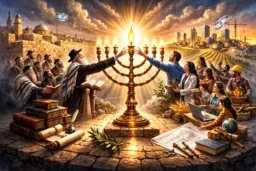
The Hanukah menorah, sometimes called the hanukiah, has its roots in the menorah-candelabra of the Temple. While there are many halakhot regarding the appearance and structure of the biblical menorah, Rashi, the great French commentator, points to a most remarkable halakhic feature that commands our attention. Regarding the Torah’s instruction to arrange the lamps in a way that they will shine “toward the menorah,”[1] Rashi explains this to mean that all the flames in the lamps should point toward the middle light.
The Italian sage and physician Rabbi Ovadia Seforno, in his masterful commentary on the Torah, elaborates on Rashi’s comments and explains that the extremists on both ends of the spectrum need to focus on the middle road, which is symbolized by the central light of the menorah. While both groups are completely dedicated to Torah and its tradition, the right-wingers need to know that without those who occupy themselves with the affairs of the mundane world, Judaism will not succeed. At the same time, the left-wingers must understand that without those who occupy themselves with the study and implementation of Torah, their worldly occupations would lack the opportunity for sanctification.
Only in a combined effort, symbolized by the middle light, will there be the degree of balance required by the Torah and Judaism. This is based on the Talmudic principle “If not for the leaves, the grapes could not exist.”[2]
A nation in miniature
Rabbi Samson Raphael Hirsch (1808–1888), known for his philosophy of Torah im Derech Eretz (the study of Torah combined with worldly occupation), comments on Yaakov’s final blessings to his children:
The nation that will descend from you is to be one single unit outwardly oriented, and a multiplicity of elements united into one—inwardly oriented. Each tribe is to represent a special national quality; is to be, as it were, a nation in miniature.
The people of Yaakov is to become “Yisrael,” is to reveal to the nations God’s power, which controls and masters all earthly human affairs, shaping everything in accordance with His Will. Hence, this people should not present a one-sided image. As a model nation, it should reflect diverse national characteristics. Through its tribes, it should represent the warrior nation, the merchant nation, the agricultural nation, the nation of scholars, and so forth. In this manner it will become clear to all that the sanctification of human life in the Divine covenant of the Torah does not depend on a particular way of life or national characteristic. Rather, all of mankind, with all its diversity, is called upon to accept the uniform spirit of the God of Israel. From the diversity of human and national characteristics will emerge one united kingdom of God.[3]
Rabbi Moshe Schreiber, the Chatam Sofer (1762–1839), offers a slightly different explanation for the halakhic requirement as to which direction the lights should face. He warns his readers not to deviate from the middle road. As long as Jewish Law is fully observed, one should not be too much of a right-winger or too much of a left-winger.[4] In other words, the call is not for the extremists to find a modus vivendi, but rather for each individual to live a life in which both extremes are avoided. The ways of God testify to religious balance. This is not to suggest a mediocre attitude toward observance or the maintaining of a religious status quo in which people no longer strive for higher spiritual dimensions. On the contrary, it advises one to understand that the ultimate goal is not to become religiously obese, but to become spiritually elevated. To become extreme is to grow plump, with the result that one topples over; to become elevated is to keep growing in smooth and continuous stages.
To walk the middle path is an art and is much more difficult than adopting an extreme position. Those who live by extremes often do so because it is more convenient. Things are black or white, clearly identifiable. Those who love the middle road have learned to perform the balancing act, which is much closer to the truth, but a great deal more challenging. Extremism reflects a simple diagnosis of the world’s problems and the conviction that everybody who disagrees is either an ignoramus or a dangerous villain.
Since the establishment of the State of Israel, the question whether the State should be governed by Jewish or by democratic values remains at the center of our national debate. Both values seem almost irreconcilable. Judaism represents a theocentric worldview in which God is placed at the center. He is the focus and absolute authority, while the democratic worldview places the people at the center.
The Law of the King
In some of the most remarkable discourses by Rabbi Nissim of Gerona (fourteenth century, Spain), also called Ran, this great Talmudist and thinker launched a theory in which he argued that Judaism does not subscribe to the idea of a full-fledged theocracy, but in fact favors a halakhic democracy.[5] He framed a daring and highly intriguing political theory that created a separation between the law of the Torah and “the law of the king”, societal law. Since Ran, like English philosopher Thomas Hobbes (1588–1679), saw the major problem of any society to be the destructive nature of humanity, he believed it necessary for the state to establish laws that deal with the reality of day-to-day life, which often does not live up to the spiritual requirements of the Torah. This theory, claims Ran, follows from the fact that the Torah demands, or at least allows, for the appointment of a king. The judges of the Sanhedrin, the rabbinical High Court of Israel, judge the people by the law of the Torah only. The king or the political establishment, however, is permitted—and even required—to judge citizens by different criteria in accordance with the needs of the time, and sometimes even against the standard ruling of the Torah.
According to this model, Halakhah seeks to create a certain duality within the Jewish polity and allows space for a democratic model in which human beings decide the law, not only God. This is with the full permission, nay, on the initiative of God Himself as reflected in the Torah. In other words, the Torah itself gives its imprimatur to state law: “Appoint yourselves shoftim [judges sitting in the Sanhedrin] and shotrim [magistrates who judge according to ‘the law of the king,’ civil law].”[6]
Likewise, the Torah writes: “Tzedek tzedek tirdof” (“Pursue perfect justice”).[7] The repetition of the word tzedek (justice) can be understood as referring to justice according to Torah Law as well as justice according to “the law of the king.”
We see here a fascinating balance between Divine law and human law. Both are represented and together allow society to function, while the law of the Torah is seen as the ultimate spiritual and moral objective.[8]
The secular government
Rabbi Avraham Yitzchak ha-Kohen Kook (1865–1935), chief rabbi of Palestine before the State of Israel was established, takes this even further and points out that although we can no longer appoint a king in Israel—since only a prophet may anoint him—we see that there were Jewish kings during the Hasmonean period of the Second Commonwealth when prophecy had already ceased. Therefore, he claims, it is possible for a secular Jewish government to be appointed, like a king, once the electorate, by means of a democratic election, decides to give it authority.[9] This he believed would be permitted and even be sanctified by Halakhah.
This, I believe, is yet another aspect of what the menorah’s design with the focus upon the middle light signifies.
Questions to Ponder
- The essay presents the “middle light” of the menorah as the Torah’s ideal. Do you experience moderation as a higher spiritual discipline—or as a dilution of conviction?
- Why do you think that extremism, or even just taking on chumrot, can so often feel more authentic than finding the middle ground?
- If walking the middle path is more difficult than adopting extremes, why do religious communities so frequently reward extremism with authority, admiration, and leadership? What does this say about our collective spiritual maturity?
- Rabbi Hirsch’s vision of Israel as “a nation in miniature” celebrates diversity of roles within a single covenant. Do you believe contemporary Jewish society still values this multiplicity—or has it replaced it with ideological uniformity?
- The Ran’s distinction between Torah law and “the law of the king” suggests that Halakhah itself authorizes non-halakhic governance. This would appear to be an admission of the limitations of Torah law.
- Can Divine law survive sharing authority with human legislation? What happens when the two conflict? Which should take precedence in practice, not in theory?
- If the king may sometimes rule against Torah law for the sake of societal stability, what becomes of Halakhah’s claim to moral supremacy?
- The idea of a halakhic democracy implies that God deliberately leaves space for human error, compromise, and political judgment. Does this strengthen your faith in Halakhah—or weaken it?
- Rav Kook’s argument that a secular government may be sanctified by democratic consent is radical. Do you believe religious legitimacy can emerge from popular will? Do you believe true integration between theocentric faith and democratic values is possible—or are we living inside a permanent contradiction? The modern State of Israel forces Jews to confront power, coercion, and responsibility. Do you think Judaism is better suited to life without sovereignty—or is this a necessary stage of moral maturation?
[1] Bamidbar 8:2.
[2] Chullin 92a.
[3] R. Samson Raphael Hirsch, The Hirsch Chumash, trans. Daniel Haberman, vol. 1 (Feldheim, 2002), 693 [Bereshit 35:11–12].
[4] R. Moshe Sofer, Torat Moshe on Bamidbar 8:2.
[5] Derashot HaRan, nos. 8 and 11.
[6] Devarim 16:18.
[7] Devarim 16:20.
[8] See Derashot HaRan, nos. 8 and 11. This differs from the view of Rambam and some other important halakhists. See, for example, Mishneh Torah, Hilchot Melachim 4:10. For other opinions, see Don Yitzchak Abarbanel (1437–1508), commentary on Devarim 16:18 and on 1 Shmuel 8:4–6; R. Yosef Hayyun (fifteenth century), commentary on Pirkei Avot, Mili de-Avot 3:2; R. Yeshaya Horowitz (c. 1565–1630; the Shelah ha-Kadosh), Shnei Luchot HaBrit, part 2, Torah Ohr on Parashat Shoftim. For a thorough study and additional sources on this topic, see Aviezer Ravitzky, Religion and State in Jewish Philosophy: Models of Unity, Division, Collision and Subordination, trans. Rachel Yarden (Israel Democracy Institute, 2002).
Also related to this issue is the fascinating disagreement between Rabbi Chaim Ozer Grodzinski (1863–1940), leading member of the Council of Sages of Agudat Yisrael prior to the Holocaust, and Rabbi Yitzchak Isaac ha-Levi Herzog (1888–1959), former chief rabbi of Israel, concerning the question of whether or not to establish a halakhic state in modern Israel. Rabbi Grodzinski, who was not a Zionist, was of the opinion that the State of Israel should adopt the approach of Ran and allow for a secular government and legal system, while Rabbi Herzog, a fervent Zionist, wanted to implement a fully halakhic state, not based on Ran’s position, but on Rambam’s legal theory! Remarkable is the fact that Rabbi Grodzinski was one of the greatest halakhic authorities and had minimum interaction with secular studies, yet he was prepared to give secular law much power in the Jewish State, while Rabbi Herzog, who was as halakhically brilliant as Rabbi Grodzinski and held several advanced degrees including a PhD, would not hear of it! Rabbi Chaim Ozer Grodzinski’s letter was published in Rabbi Yitzchak Isaac ha-Levi Herzog, Techuka le-Yisrael al Pi HaTorah, ed. I. Warhaftig (Mossad HaRav Kook, 1989), 2:75. For more information about this debate, see ibid., 65–89; Ravitzky, Religion and State in Jewish Philosophy, 11–14.
[9] Mishpat Kohen, no. 144, section 14.
Rabbi Nathan Lopes Cardozo
Rabbi Dr. Nathan Lopes Cardozo is the Founder and Dean of the David Cardozo Academy and the Bet Midrash of Avraham Avinu in Jerusalem.
A sought-after lecturer on the international stage for both Jewish and non-Jewish audiences, Rabbi Cardozo is the author of 13 books and numerous articles in both English and Hebrew.
He heads a Think Tank focused on finding new Halachic and philosophical approaches to dealing with the crisis of religion and identity amongst Jews and the Jewish State of Israel.
Hailing from the Netherlands, Rabbi Cardozo is known for his original and often fearlessly controversial insights into Judaism. His ideas are widely debated on an international level on social media, blogs, books and other forums.